Showing posts with label Islam. Show all posts

Thursday, 13 January 2011

After Salman Taseer: Follow-up on Secularism and Despair

One of the nicest things (as well as one of the most terrifying) about having a blog is the opportunity to see your thoughts frozen in time and be able to return to them later, thinking either, "Wow, that was smart" or "I'm a complete idiot." This has happened several times since I started writing in the summer of 2008, when I was not yet a senior in college, and into my second year of graduate school where I am today. Sometimes I looked like an idiot: after my first trip to India, I expressed surprise an Indian Muslim might idolise Subhas Chandra Bose (talk about a blinkered "communalist" perspective on life). Other times I was prescient even when I didn't know what I was talking about: without a real insight into caste politics, I got a sense of the peculiar bind many observers feel when attempting to analyse Mayawati. After living in Lucknow for a summer and reading more, I realise I was right in thinking there is no one answer, even among the different Dalit visions of politics. Some (like Christophe Jaffrelot) will largely applaud her for making Dalits visible and challenging the very real caste power structures at work in her state. Others, including some radical Dalit critics, might see a surrender to the lure of the state as an instrument of policy and a failure to focus on development and social issues at the expense of symbolic ones.
My point is, I've rarely been tempted to edit myself or take down old posts because a blog, unlike official academic writing, can serve as a freer and more experimental venue to work out ideas. Especially when no one reads it!

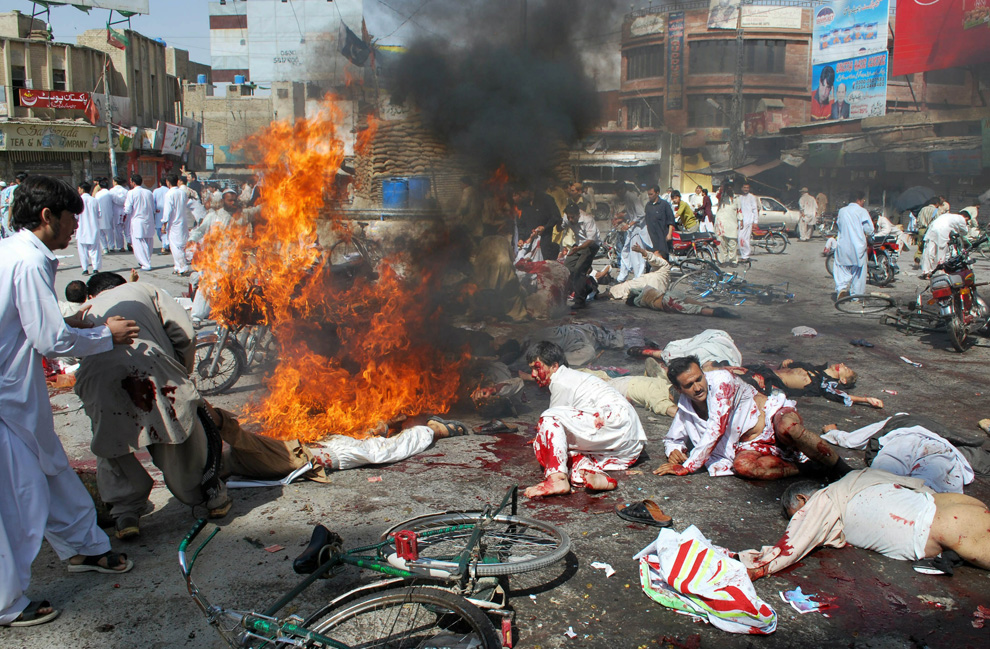
After the assassination of Salman Taseer, Punjab's governor, in retaliation for his public support for Asiya Bibi, a Christian woman sentenced to death under Pakistan's blasphemy laws, I didn't think so much as I felt. My first instinct was not to be a good academic and explain, contextualise or give nuance to the phenomenon of "extremism" or "fundamentalism." I just felt anger, and sadness, and deep confusion as to what fighting these people, or fighting for Pakistan might mean. The important thing is that I did see it in terms of a fight, a desperate struggle. For what? I couldn't say, but at least so that nothing like this would happen again. We're all conditioned, as academics, to be wary of emotional manipulation, but news report after news report of bombings in Pakistan, and gruesome photographs of dead bodies lying in the streets, can really get to you after a while. Seeing the outpouring of support for Taseer's killer - he was quite literally showered with rose petals - deepens the feeling. But I also know that by "fight" I don't mean more American drones, or a new military dictator in Islamabad, or even rallying around the banner of something called "secularism."

In August, I wrote a piece that challenged writer Aatish Taseer's vision of Pakistan. I thought that his call for Pakistan to recapture its lost "Indianness" masked an insensitivity to the country's legitimacy, and I accused him of wanting to save Pakistan without loving it. Now, reading his moving eulogy to his estranged father, I feel a bit embarrassed. Why should Aatish, born in India, raised by his mother, and largely unacknowledged by his father, feel any love for Pakistan? And how would he feel now, after seeing his father murdered by religious extremists? What right do I have to nuance his statements about the threat of the "bearded men"? But I was still right in the end. Aatish passionately believes that, "Pakistan and its founding in faith, that first throb of a nation made for religion by people who thought naively that they would restrict its role exclusively to the country's founding, was responsible for producing my father's killer." Indeed, this was the very reason father and son drifted apart. If Salman was a "Pakistani patriot," Aatish explicitly didn't believe that Pakistan should even have come into being. What room for compromise?
By itself, the statement that the idea of Pakistan was a doomed experiment from the start is not exceptional or particularly objectionable. But Aatish Taseer's solution is troubling: he wishes that "science and rationality" had been "enshrined at the heart" of the nation instead of religion. By extension, should we combat men like Malik Mumtaz Qadir (the assassin) with science and rationality? What chance do these concepts have against the powerful lure of religion; who would then shower him with rose petals?

This debate reminds me of another dead-end, the fate of state-sponsored "disenchanted" secularism in India. After the Ayodhya verdict, when a sitting judge declared he had determined the actual birthplace of Lord Ram, I experienced the same kind of reactionary despair. "To hell with academic critiques of secularism: fight this superstition to the end!" The problem is that the academics may be right. Secularism alone, and science or rationality alone, are not enough to persuade people to stop seeing themselves as having a set of religious or communitarian interests they must defend to the death.

So if we don't have secularism, and we don't want to fall back on state violence, the only thing we have left is ethics. That is to say, human-to-human, day-to-day interaction. What makes the blasphemy laws and the Ayodhya judgment wrong is not so much that they are superstitious or irrational, but that they destroy the ability of human beings - Christians in Pakistan, Muslims and other minorities in India - to live in peace, to move freely through the cities and villages, to draw water or sell their goods in the bazaars, to express themselves without fear of violence or retribution. These are not even necessarily "human rights" at a universal level. They are local and intimate affairs. With regard to Pakistan, what is most urgently needed is not advocating for science and a secular state - an agenda sure to enrage clerics and disaffected young men like Malik Mumtaz Qadir even further. It is, somehow and in a diffuse and imperceptible way, to cultivate an atmosphere where individuals look upon their neighbours with compassion and mutual sympathy. Notions like "pluralism" and "tolerance" are not political slogans; they are ethical targets for individuals to re-train their sensibilities away from conspiracy and paranoia and toward genuine understanding of the lives of others. It may sound like a naive proposition, but it's actually a realistic description of what happens almost every time individuals come into contact without mutual suspicion and violence anywhere in the world. Yes, even in Pakistan.

Wednesday, 24 February 2010

The Affaire Gita Sahgal: New Fault Lines

As someone whose research has explored the nearly insurmountable contradictions in the conflicts over the "right to represent" in the international women's question, I was primed to react in a certain way to the news that Gita Sahgal was suspended from her post as head of Amnesty International's Gender Unit. She had called attention to the organisation's suspect association with Moazzam Begg, former Guantanamo prisoner and head of charity Cageprisoners, which supposedly has links to the Islamic Right (for instance, by promoting the notorious Anwar al-Awlaki). Her statement and story here:
http://www.outlookindia.com/article.aspx?264244
http://www.outlookindia.com/article.aspx?264315

My reaction, especially after seeing Salman Rushdie's spirited defence of Sahgal, was suspicion. I remember seeing Rushdie speak ca. 2004, just as my own views on the invasion of Iraq were changing, and realising with some chagrin that he had become in some important ways an apologist for neo-conservative neo-imperialism. But is Sahgal another Ayaan Hirsi Ali, an "establishment feminist" championed by the "enlightened" anti-Muslim literati, hiding a sinister agenda? A glance at the petition supporting her should dispel such doubts:
http://www.human-rights-for-all.org/spip.php?article15

As an aspiring academic, I have my intellectual heroes and political guiding lights. Much to my surprise, so many of them are here: Sumit and Tanika Sarkar, Romila Thapar, Amitav Ghosh, Gayatri Spivak, Ramachandra Guha, Dilip Simeon, Chitra Joshi, Sumit Guha, Suvir Kaul, Raka Ray, Zoya Hasan, Amita Baviskar, Madhu Sarin, Priyamvada Gopal, and more.
One astonishing thing about this list is that it includes both mainstream liberals and various shades of Left-Marxist academics and activists. The even more astonishing thing is that almost all are fierce critics of communalism and imperialism.

This event shows that opposing the formulation of a Muslim problem with the potential of disrupting peaceful co-existence in India and beyond (which I have written about in my previous posts on the legacy of Gujarat and the controversy at the Jaipur Lit Festival) does not, should not, and can never imply fear or retreat from criticising Islamic Right ideologies. The strongest weapon in the hands of people like Hirsi Ali, Rushdie, Hitchens, Pascal Bruckner and the whole "new Enlightenment" intelligentsia is the idea that Left intellectuals are "soft on Muslims." This also forces us (I humbly include myself in the latter category) to desperately contemplate the impossibility of ethical action in the space between the Taliban and the neo-con. What Gita Saghal can teach us, apart from how to bravely go about doing this, is that there are points of commonality and even solidarity between these two factions of "late liberalism." Being vigilant about the dangers of extremisms of all kinds, and yes, still ever-conscious of the vast challenges facing women under various regimes of patriarchal oppression, is quite simply the right thing to do. Convergence on this point has the potential to restructure the intellectual and political field away from the many harmful complicities of the 2000s, and just maybe salvage the integrity of "human rights."

Sunday, 7 February 2010

Danger! More on Indian Muslims and the Possibility of an "International Communalism"

If what I read in the Wall Street Journal is indicative of things to come, then we're in trouble. A report that should have been innocuous on the Jaipur Literature Festival by journalist and author Sadanand Dhume on Ayaan Hirsi Ali's speech turns into something very sinister. I expected the commentary to briefly mention that she is "controversial" and maybe say a thing or two about her reception. Instead, the title of the article promised much more, purporting to show how "globalization is changing the debate" about Islam in India:
http://www.asianwindow.com/books/indias-groupthink-on-islam/

Alright, let's go. Right off the bat, Dhume is shockingly brazen in asserting that Ms. Hirsi Ali's well-rehearsed screed about the evils of Islam is delivered "with a frankness unfamiliar to most Indians." As Charu Gupta's excellent work on the Hindi public sphere in the early 20th-c. has shown, the stereotype of Muslims as sexually and developmentally backward was entrenched in the earliest formulations of Hindu nationalist identity, and was widely disseminated (see her Sexuality, Obscenity, Community: Women, Muslims and the Hindu Public in Colonial India). Moreover, when respectable Hindu social reformers (like M.G. Ranade in Maharashtra) in the late 19th-c. sought to explain the deplorable state of Indian women under indigenous patriarchy, they firstly and loudly blamed the Muslim invasions for putting an end to the "Golden Age" of women's freedoms under Hinduism. But we don't need to go that far backward and into that much detail. Speak with many educated, "globalised" and "modern" Indians today, or flip through the news channels, and you'll see a picture of Indian Muslims (a disadvantaged minority, after all) quite consistent with Ms. Hirsi Ali's generalisations. Unfamiliar? Hardly.

In a surreal escalation of stupidity, after once more repeating that only with the past 20 years of globalisation is India "starting to grapple with the faith [Islam]" (rendering the past 800 years of coexistence on the subcontinent irrelevant), Dhume claims that the failure to think about Muslims in the way he wants Indians to is due to "the kind of groupthink fostered by decades of socialism." What in the world is he talking about? He cannot possibly mean that the relative absence of serious communal violence during the first few decades of Indian independence, at least when contrasted with the past 20 years (post-Ayodhya, Gujarat), is something we should blame Nehruvian socialism for. Or maybe he means that today's presence of radicalised strains of Islam (i.e. terrorism) had its roots in state socialism's failure to...do what exactly? And how come these radicalisms have proliferated precisely in the era of globalisation he claims is helping Indians "think" better about Islam? Dhume doesn't care to elaborate.

Aha! This is what it's all about: apparently, "mainstream intellectuals...tend to trace the Muslim world's problems almost exclusively to the alleged misdeeds of Israel and the United States." What kind of media is this fellow watching, and what is he smoking all the while? Lest he be accused of unfairness, Dhume admits that the Hindu right isn't all that great because it has a "tendency to group all Muslims together" (tendency?) and its policy "shades into bigotry and religious chauvinism" (shades??). Amazingly, he then claims that Ms. Hirsi Ali is a moderate walking the middle path (whatever you think of her, a moderate of any kind she is not). While she may say bad things about fundamentalism, she also "urged the audience to think of Muslims as 'individuals who are capable of changing their mind.'" My oh my, how charitable of her!

Contradicting the straw man he has himself set up, Dhume lists several authors at the festival who similarly challenge the "mainstream Indian narrative": Tunku Varadarajan, Max Rodenbeck, Lawrence Wright, and Steve Coll. Notice that not only does he not define what this mysterious "mainstream" narrative is, but he can't name a single person who defines it or subscribes to it. Thus, it would seem from his own evidence that the majority of "mainstream intellectuals" (the authors named above come from The Economist, Daily Beast, and the New Yorker) are of his, and Ms. Hirsi Ali's, opinions about Islam.

But the most blatant abuse of journalistic integrity and common sense comes when Dhume attempts to show the "other side." What kinds of arguments might be made against Ms. Hirsi Ali's positions? He cites no academic studies, no political commentaries or respectable authorities who might have intelligent rebuttals. Instead, he refers to "slightly hostile" audience members who are not so "tolerant" (this is just open condescension on his part, as if any kind of contradictory questioning is intolerance). Let's see who he finds:
1) A "young Kashmiri Muslim man" accuses a panel discussing the "Arab-Muslim penchant for conspiracy theories" of "promoting stereotypes" and being "spokespersons for the mainstream media." The way he writes it, we're supposed to think he's crazy. It sounds to me quite reasonable to say they were promoting stereotypes, and the credentials of the panelists indicate they are precisely spokespersons for the mainstream media, no quotes needed.
2) A professor of history at Delhi University "said he would 'defy anyone with the slightest sense of justice' to say what was happening in Palestine was 'fair.'" Tellingly, the professor is not named or interviewed later, as he is the only source with some kind of authority that might destabilize Dhume's argument. Also, this is again presented as a rambling diatribe when in fact it's a very sensible little statement: very few people with a sense of justice would say that what's happening in Palestine is fair. Yet we move on...
3) Javed Akhtar, the great Urdu poet and lyricist, presented as a "writer of Bollywood lyrics" (he's like, their Randy Newman, you see!) says some extreme-sounding things like that all Islamic fudamentalism is supported by the US (this was kind of maybe true until the late 1980s, but obviously stupid to say about today), and that the US is deliberately concealing bin Laden's death. So he's a bit nutty. But Javed Uncle is NOT an authority on policy and shouldn't be the best thing Dhume can muster for his article. That's like running an article about an academic forum on contemporary Jewishness to which Mel Gibson shows up and quoting him as a dissenting view. Pathetic.

In the end, Dhume predicts "the slow but inexorable knitting of India into the mainstream of global discourse on a sensitive subject." He means it as a triumphalist statement, but the state of global discourse on this very sensitive subject is abysmal. Herein lies the danger, and I do not use this word lightly, of this kind of thinking. Dhume's article by itself won't do the damage, but the trend that he is describing (if we notice it to be true) will.
India, a country with ca. 160 million Muslims, has been able to maintain internal religious harmony, with several grievous exceptions. These very exceptions point to its vulnerability; if the Indian public sphere does take on a more strident anti-Muslim tone, as promoted by neoconservative radicals like Ms. Hirsi Ali and the "mainstream" experts admired by the hapless Dhume in the West, disaster would follow. It's easy for the Swiss to fret about four minarets and symbolically punish a few thousand "black sheep." In a country with a long and bloody history of communal violence, rhetoric of this kind is playing with fire. Ayodhya is the test case, so this need not be a hypothetical. Not only would the consequences of escalating mistrust and conflict be grievous for the safety, security and peace of millions of Indian Muslims, it would further radicalise Islamic fundamentalist elements and give rise to more acts of terrorism. India would no longer be a country that knows how to "deal" with its Muslims, which even Ms. Hirsi Ali acknowledges in her speech (though this is too subtle for Dhume to pick up on).

If this odious little piece is to be believed, we may have to worry about more than just the communalism of "khaki shorts and saffron flags," but of a more insidious "international" communalism that seeks to disturb what is, for the moment, a tensely peaceful scene.