Showing posts with label manifestos. Show all posts

Thursday, 13 January 2011

After Salman Taseer: Follow-up on Secularism and Despair

One of the nicest things (as well as one of the most terrifying) about having a blog is the opportunity to see your thoughts frozen in time and be able to return to them later, thinking either, "Wow, that was smart" or "I'm a complete idiot." This has happened several times since I started writing in the summer of 2008, when I was not yet a senior in college, and into my second year of graduate school where I am today. Sometimes I looked like an idiot: after my first trip to India, I expressed surprise an Indian Muslim might idolise Subhas Chandra Bose (talk about a blinkered "communalist" perspective on life). Other times I was prescient even when I didn't know what I was talking about: without a real insight into caste politics, I got a sense of the peculiar bind many observers feel when attempting to analyse Mayawati. After living in Lucknow for a summer and reading more, I realise I was right in thinking there is no one answer, even among the different Dalit visions of politics. Some (like Christophe Jaffrelot) will largely applaud her for making Dalits visible and challenging the very real caste power structures at work in her state. Others, including some radical Dalit critics, might see a surrender to the lure of the state as an instrument of policy and a failure to focus on development and social issues at the expense of symbolic ones.
My point is, I've rarely been tempted to edit myself or take down old posts because a blog, unlike official academic writing, can serve as a freer and more experimental venue to work out ideas. Especially when no one reads it!

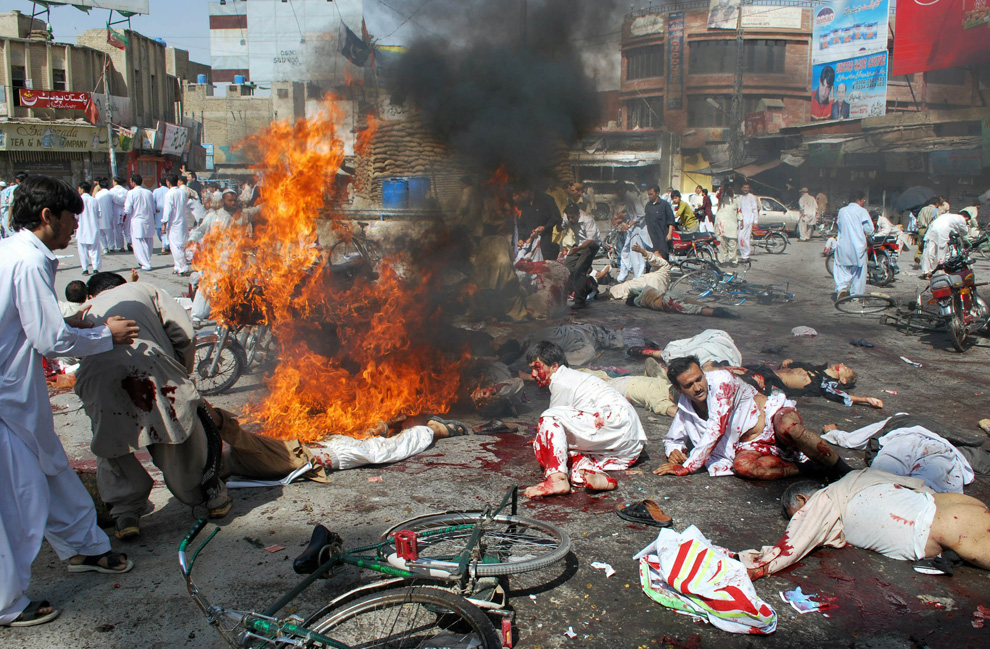
After the assassination of Salman Taseer, Punjab's governor, in retaliation for his public support for Asiya Bibi, a Christian woman sentenced to death under Pakistan's blasphemy laws, I didn't think so much as I felt. My first instinct was not to be a good academic and explain, contextualise or give nuance to the phenomenon of "extremism" or "fundamentalism." I just felt anger, and sadness, and deep confusion as to what fighting these people, or fighting for Pakistan might mean. The important thing is that I did see it in terms of a fight, a desperate struggle. For what? I couldn't say, but at least so that nothing like this would happen again. We're all conditioned, as academics, to be wary of emotional manipulation, but news report after news report of bombings in Pakistan, and gruesome photographs of dead bodies lying in the streets, can really get to you after a while. Seeing the outpouring of support for Taseer's killer - he was quite literally showered with rose petals - deepens the feeling. But I also know that by "fight" I don't mean more American drones, or a new military dictator in Islamabad, or even rallying around the banner of something called "secularism."

In August, I wrote a piece that challenged writer Aatish Taseer's vision of Pakistan. I thought that his call for Pakistan to recapture its lost "Indianness" masked an insensitivity to the country's legitimacy, and I accused him of wanting to save Pakistan without loving it. Now, reading his moving eulogy to his estranged father, I feel a bit embarrassed. Why should Aatish, born in India, raised by his mother, and largely unacknowledged by his father, feel any love for Pakistan? And how would he feel now, after seeing his father murdered by religious extremists? What right do I have to nuance his statements about the threat of the "bearded men"? But I was still right in the end. Aatish passionately believes that, "Pakistan and its founding in faith, that first throb of a nation made for religion by people who thought naively that they would restrict its role exclusively to the country's founding, was responsible for producing my father's killer." Indeed, this was the very reason father and son drifted apart. If Salman was a "Pakistani patriot," Aatish explicitly didn't believe that Pakistan should even have come into being. What room for compromise?
By itself, the statement that the idea of Pakistan was a doomed experiment from the start is not exceptional or particularly objectionable. But Aatish Taseer's solution is troubling: he wishes that "science and rationality" had been "enshrined at the heart" of the nation instead of religion. By extension, should we combat men like Malik Mumtaz Qadir (the assassin) with science and rationality? What chance do these concepts have against the powerful lure of religion; who would then shower him with rose petals?

This debate reminds me of another dead-end, the fate of state-sponsored "disenchanted" secularism in India. After the Ayodhya verdict, when a sitting judge declared he had determined the actual birthplace of Lord Ram, I experienced the same kind of reactionary despair. "To hell with academic critiques of secularism: fight this superstition to the end!" The problem is that the academics may be right. Secularism alone, and science or rationality alone, are not enough to persuade people to stop seeing themselves as having a set of religious or communitarian interests they must defend to the death.

So if we don't have secularism, and we don't want to fall back on state violence, the only thing we have left is ethics. That is to say, human-to-human, day-to-day interaction. What makes the blasphemy laws and the Ayodhya judgment wrong is not so much that they are superstitious or irrational, but that they destroy the ability of human beings - Christians in Pakistan, Muslims and other minorities in India - to live in peace, to move freely through the cities and villages, to draw water or sell their goods in the bazaars, to express themselves without fear of violence or retribution. These are not even necessarily "human rights" at a universal level. They are local and intimate affairs. With regard to Pakistan, what is most urgently needed is not advocating for science and a secular state - an agenda sure to enrage clerics and disaffected young men like Malik Mumtaz Qadir even further. It is, somehow and in a diffuse and imperceptible way, to cultivate an atmosphere where individuals look upon their neighbours with compassion and mutual sympathy. Notions like "pluralism" and "tolerance" are not political slogans; they are ethical targets for individuals to re-train their sensibilities away from conspiracy and paranoia and toward genuine understanding of the lives of others. It may sound like a naive proposition, but it's actually a realistic description of what happens almost every time individuals come into contact without mutual suspicion and violence anywhere in the world. Yes, even in Pakistan.

Thursday, 12 November 2009

The Lesson of Gujarat, or How to Talk about Events

That the recent tragedy at Fort Hood should raise the spectre of anti-Muslim hysteria in the U.S. is by now commonplace. But the real stakes of the debate, namely the precise consequences of a certain way of thinking about events and their repercussions, are obscured by placing the focus of the debate around "how much Islam has to do with it." Framing the shootings of U.S. servicemen by this individual Hasan in the language of "terrorism" or "Islamic fundamentalism" is undoubtedly problematic. But to respond, those of us who wish to re-frame the issue are inevitably forced into a kind of obscurantist cul-de-sac that allows no discussion of Islam or Muslims whatsoever: that this is an isolated act of a "mentally unstable" person, that religion has "nothing to do with it." What we grapple with, in essence, is the singularity of the act and its relationality to a wider field of discourses, or ways of talking about things (in this case, Islam and Muslims).

Here is what I mean: whenever such events occur and are disseminated through the media, as they inevitably will in our globalised age, we should avoid the temptation of seeing them as exceptions, as acts that stand alone in the world, infinitely contingent. Instead, we should accept from the start that they will immediately feed into a vast discursive terrain of things being said, worked out and worked over, about macro-categories we are uncomfortable with, yet ignore at our peril. We should follow this event through the discursive terrain and see where it lands, and thus make visible the consequences of its particular path. The relational consequences of singular events are often so jarring that they might yet enable many (with the exception of those who are willing to pay the price), to look at the terrain anew and be made aware of the treacherous channels through which information travels and is re-directed, of how events acquire meanings.

I will use the example of the 2002 Gujarat massacres to make my point. Here, a much-disputed and yet very "real" event, the burning of 58 Hindus in a train coach in Godhra, happened in all its garish and horrifying singularity. Whether it was deliberate arson by a mob or something else, whether the categories of Hindu victims and Muslim attackers should be deconstructed, are all important yet tangential issues. Trying to disentagle religion and politics, local contexts and broad phenomena etc. etc. from the charred remains of this event, though ethical and honest in a scholarly sense, is mere impotence in the face of what happened next, when as many as 2,000 Muslims were massacred while the state not only stood by, but actively aided and encouraged the violence. A confrontation between certain individuals at a certain point in time was a spark to a fire that burned along the axes of Big categories, "Hindu" and "Muslim," all across Gujarat. In Amitav Ghosh's novel The Shadow Lines, the traumatic riots in Calcutta and Dhaka of 1964, which so decisively shape the characters' lives, can be traced back to an incident in far-away Kashmir over a stolen relic. Singular events become relational to contexts far distant in time and place. If we have a truly political, indeed moral, task in our complicated world, where information travels at once faster and more insidiously than ever, it is to break the links that are formed in this way.

What would it mean to think of Godhra, minutes or hours after it happened, with the bodies of 2,000 innocent people in mind? What would it mean to follow the contention that an individual Hasan stands in for a "Muslim problem" that must be faced, to its logical conclusion, to a widespread and concerted effort by individuals and the state to "deal" with it? The consequences of thousands of lives lost when so many minds are fixed (or being fixated) onto a category, in this case of the problematic Muslim that must be dealt with, are not worth the mental leap. There are those who will say that such violence is the inevitable result, or collateral damage, of whichever side they think is to blame acting wrongly. Yes, 2,000 Muslims died, but that's because they started it. This is, I would hope, only a small minority of those who are engaged in the conversation. The task for scholars, activists, and all of us concerned about these issues is to show that the price to pay, of creating a climate for civil violence, is far more de-stabilising to the security and internal peace of communities than a singular act unavenged, or a problematic category not properly dealt with. This is especially true in the United States, where the potential for reprisals is always high yet, with almost no exceptions, since September 11th no serious and sustained civil violence has occurred. India's lessons, from the Sikh massacres of 1984 to Gujarat and on, are vital in this regard. Communal bloodshed on general lines, visited upon individuals whose only connection to singular events from another place and time lies in the relation with those events constructed in people's minds, is a price too steep to ever pay. To suppress this urge to relate the singular, to think of unrealised consequences instead of the real and visceral event that has just happened, is admittedly difficult but it is also urgent.

Tuesday, 15 September 2009

The Post-Colonial State in Our Time

Yesterday, I attended a talk given by Vijay Prashad, professor at Trinity College in Connecticut and author, most recently, of The Darker Nations: A People's History of The Third World. Much of what he said is not strictly speaking original, but the interpretive framework he is after promises to bring together many disparate phenomena operating across the developed/developing world divide, from urban gentrification to the creation of financial bubbles. To understand the current world order, Prashad takes us back to the imagination of an alternative path, the Third World dream of liberation and self-assertion; through it, as Fanon once said, formerly colonised societies would achieve what Europe could not.

From an economic and geographic perspective, this vision is decidedly not new: we see the invocation of the old I.S.I. (import-substitution-industrialisation) model set against today's neoliberal tyranny, the South-North resource flow as "accumulation by dispossession" (Prashad quotes David Harvey on this), and so on. But in a cultural sense, the awareness of the immediate postwar aftermath as an age of new global connections, which I discussed earlier in the context of Amitav Ghosh's essay on Hindi films in the non-Western world, is a fruitful area of historical thinking that is just now coming to the fore. Prashad's focus on major state figures like Nehru, Nasser and Sukarno, and on high-level events like the Bandung conference, thus serves a dual purpose: to render new cultural meanings to traditional diplomatic and political narratives (showing how these figures were important to a deep and wide movement that thought of the world differently, not just seeing them as another Cold War power bloc), and to argue that the idea of the Third World was institutionally anchored in state and transnational power (the implicit contrast is to today's fragmented, subterranean, ragtag resistances epitomised by the World Social Forum). The destruction or "assassination," in his term, of these power structures represented the real death of the dream in the late 1970s.

After his vibrant and provocative presentation, I asked Prashad a nagging question. On the one hand, he still views the "Global South" as a viable force in international relations, and he is interested in studying the developmental models and pathways of "BRIC" (Brazil-India-China) nations as an alternative to the current U.S.-dominated world order. But on the other hand, he rightly pointed out that India's current government continues to send heavy subscriptions to the IMF and is even seeking to restart the Doha round. Is the post-colonial state not now part of the very process that creates an "accumulation by dispossession"? Can it be part of a "globalising" world economy and a source of resistance to it at the same time? Prashad's answer was that elections matter and things may change. The Indian state does not essentially have one role or another, but its policies swing back and forth; therefore, it is also susceptible to influence, to the contingent democratic process. An electoral victory, for example, would presumably reconfigure the state on the world stage. Such a faith in popular democracy to triumph over large-scale structures is in many ways not traditional Marxism at all. It relies instead on forging innovative links between local resistances and state power, and not in the least on a considerable degree of optimism.

Monday, 15 September 2008

Eagleton's Manifesto

Feel how you like about Terry Eagleton and his politics: the man has the unique talent to cut with razor-sharp language. They are precision cuts, even paper cuts that get under the skin of his intellectual opponents, who often find themselves unable to muster replies of comparable clarity. I have to say at the outset, I do not agree with Eagleton's far-too-orthodox-for-the-21st-century Marxist programme, but his critiques must be not only addressed, but embraced, by those of us who care about post-colonialism and theories of resistance.

His stone-cold brilliant essay on Gayatri Chakravorty Spivak, entitled "In the Gaudy Supermarket," is the single most important piece on the use of language in contemporary thought since George Orwell's "Politics and the English Language." It should be more than that: a manifesto for the academic, the polemicist, and anyone interested in promoting a critical view of the world. The link to the whole thing is here:

http://www.lrb.co.uk/v21/n10/eagl01_.html

and though it is worth a careful read, all one really needs to quote to get the point across is this wonderful opening salvo:


"The second rule of this samizdat handbook reads: ‘Be as obscurantist as you can decently get away with.’ Post-colonial theorists are often to be found agonising about the gap between their own intellectual discourse and the natives of whom they speak; but the gap might look rather less awesome if they did not speak a discourse which most intellectuals, too, find unintelligible. You do not need to hail from a shanty town to find a Spivakian metaphorical muddle like ‘many of us are trying to carve out positive negotiations with the epistemic graphing of imperialism’ pretentiously opaque. It is hard to see how anyone can write like this and admire the luminous writings of, say, Freud. Post-colonial theory makes heavy weather of a respect for the Other, but its most immediate Other, the reader, is apparently dispensed from this sensitivity. Radical academics, one might have naively imagined, have a certain political responsibility to ensure that their ideas win an audience outside senior common rooms. In US academia, however, such popularising or plumpes Denken is unlikely to win you much in the way of posh chairs and prestigious awards, so that left-wingers like Spivak, for all their stock-in-trade scorn for academia, can churn out writing far more inaccessible to the public than the literary élitists who so heartily despise them."


Any college undergraduate can sympathise with the quotes he chooses from Spivak (they are only infinitesimally more comprehensible when in context), having encountered such "drivel" many times in their education. But what is at stake is not by any means the desire to simplify complex matters for the sake of understanding. On the contrary, Eagleton argues, there is something profoundly pernicious about this kind of hyper-language because it conceals fairly modest and muddled politics. What kind of resistance can this inspire? What kind of intellectual clarity will this provide to someone mired in Enlightenment assumptions and all the other post-colonial bogeys? The tragic thing about Spivak and the hundreds of critics in her wake is that they make post-colonial thought, which is at heart a remarkably incisive body of knowledge, into something obscure and unappealing. Even Foucault, buried underneath the impossible sentence formation of his rather clumsy French, has a certain impishness and instability that can captivate the reader. Most of the post-Saidian academic world in the US and UK is dry as dust by comparison. So what if their politics are modest? To me it seems such politics are preferable to Eagleton's Marxism. But not if they are served to the world as cold porridge and serve to inspire in students looking for alternatives to the dominant discourses an overwhelming feeling of "meh."

Even bona fide revolutionary heroes, like Michael Hardt and Antonio Negri, whose book Empire was a global best-seller in 2000 and advocated a comprehensive, original worldview of our globalised world, fall prey to this. Their politics are the very opposite of modest; their language is the stilted jargon of post-colonialism's muddy waters. Consider this:
"Precisely by bringing together coherently the different defining characteristics of the biopolitical context that we have described up to this point, and leading them back to the ontology of production, we will be able to identify the new figure of the collective biopolitical body, which may nonetheless remain as contradictory as it is paradoxical."
Needless to say it's a far cry from "Workers of the world, unite," and raises the question as to whom is this work even meant to speak? Certainly not the multitude, whose spontaneous acts of resistance, from the LA riots to the World Social Forum, are grounded in much more prosaic concerns than, "How contradictory is the collective biopolitical body?" The audience is more likely a coterie of Western academics who have accumulated enough to immerse themselves in Foucault and Deleuze at their leisure, and a marginalised group of radical activists who form as far from a "multitude" as conceivable. Indeed, Hardt and Negri's attempts to provide Marx-like imagery, as in their modification of his working-class-as-mole metaphor to resistance-as-a-snake, are pale imitations and do not burn with the urgency of now. Marx and Engels's manifesto required nothing from its readers than an observant eye to the realities of the world, and their language reflected this (thus, the notion of the expanding bourgeoisie was not just a nice turn of phrase but described a tangible process raging all around). For whatever their ideas were worth, they were expressed in a uniquely purposeful language (Eagleton uses Freud as an example, who also fits this description).

The way to inspire resistance, both as critical inquiry within academia and as political activism, is to use metaphors that are fiery and earthy, not airy and watery. This means they have to be urgent and contextually grounded, not abstract or muddled. The post-Foucauldian concern with the body is a perfect example of how a valuable perspective can be lost. When the body became a mere "site of resistance" or "vehicle of power" and theorists stopped talking about the body, materiality was lost and we came down the winding road to Hardt and Negri's generally superficial references to the "biopolitical." This confuses and turns off even the most well-meaning students, even those with an understanding of Foucault (perhaps especially them).

Critics have responded to Eagleton's attack in a predictably dull fashion. Judith Butler complained that Eagleton doesn't get how much Spivak's work has "inspired" all sorts of activists around the world. To which the rejoinder would question how much of Spivak they really understood, what they actually did with this theory, and whether they're succeeding. Not to mention how much more inspired they could have been with clearer prose. These are simple considerations, perhaps below Butler and the academic establishment's wide horizon. But Occam is due for a comeback sometime this century. Perhaps the most inspiring thing Spivak ever produced is not her venerable body of obscurantist text but her charitable foundation promoting literacy in India. And perhaps post-colonial theory needs re-directing to that most simple concept of all, the American grammar school's number one rule of writing: show, not tell.