Showing posts with label Pakistan. Show all posts

Thursday, 13 January 2011

After Salman Taseer: Follow-up on Secularism and Despair

One of the nicest things (as well as one of the most terrifying) about having a blog is the opportunity to see your thoughts frozen in time and be able to return to them later, thinking either, "Wow, that was smart" or "I'm a complete idiot." This has happened several times since I started writing in the summer of 2008, when I was not yet a senior in college, and into my second year of graduate school where I am today. Sometimes I looked like an idiot: after my first trip to India, I expressed surprise an Indian Muslim might idolise Subhas Chandra Bose (talk about a blinkered "communalist" perspective on life). Other times I was prescient even when I didn't know what I was talking about: without a real insight into caste politics, I got a sense of the peculiar bind many observers feel when attempting to analyse Mayawati. After living in Lucknow for a summer and reading more, I realise I was right in thinking there is no one answer, even among the different Dalit visions of politics. Some (like Christophe Jaffrelot) will largely applaud her for making Dalits visible and challenging the very real caste power structures at work in her state. Others, including some radical Dalit critics, might see a surrender to the lure of the state as an instrument of policy and a failure to focus on development and social issues at the expense of symbolic ones.
My point is, I've rarely been tempted to edit myself or take down old posts because a blog, unlike official academic writing, can serve as a freer and more experimental venue to work out ideas. Especially when no one reads it!

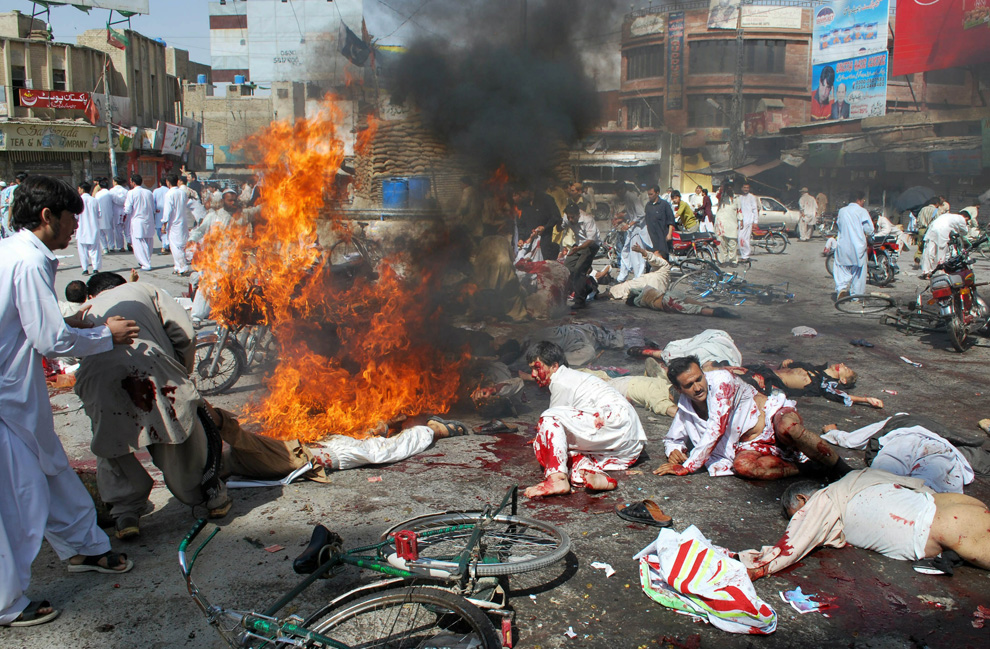
After the assassination of Salman Taseer, Punjab's governor, in retaliation for his public support for Asiya Bibi, a Christian woman sentenced to death under Pakistan's blasphemy laws, I didn't think so much as I felt. My first instinct was not to be a good academic and explain, contextualise or give nuance to the phenomenon of "extremism" or "fundamentalism." I just felt anger, and sadness, and deep confusion as to what fighting these people, or fighting for Pakistan might mean. The important thing is that I did see it in terms of a fight, a desperate struggle. For what? I couldn't say, but at least so that nothing like this would happen again. We're all conditioned, as academics, to be wary of emotional manipulation, but news report after news report of bombings in Pakistan, and gruesome photographs of dead bodies lying in the streets, can really get to you after a while. Seeing the outpouring of support for Taseer's killer - he was quite literally showered with rose petals - deepens the feeling. But I also know that by "fight" I don't mean more American drones, or a new military dictator in Islamabad, or even rallying around the banner of something called "secularism."

In August, I wrote a piece that challenged writer Aatish Taseer's vision of Pakistan. I thought that his call for Pakistan to recapture its lost "Indianness" masked an insensitivity to the country's legitimacy, and I accused him of wanting to save Pakistan without loving it. Now, reading his moving eulogy to his estranged father, I feel a bit embarrassed. Why should Aatish, born in India, raised by his mother, and largely unacknowledged by his father, feel any love for Pakistan? And how would he feel now, after seeing his father murdered by religious extremists? What right do I have to nuance his statements about the threat of the "bearded men"? But I was still right in the end. Aatish passionately believes that, "Pakistan and its founding in faith, that first throb of a nation made for religion by people who thought naively that they would restrict its role exclusively to the country's founding, was responsible for producing my father's killer." Indeed, this was the very reason father and son drifted apart. If Salman was a "Pakistani patriot," Aatish explicitly didn't believe that Pakistan should even have come into being. What room for compromise?
By itself, the statement that the idea of Pakistan was a doomed experiment from the start is not exceptional or particularly objectionable. But Aatish Taseer's solution is troubling: he wishes that "science and rationality" had been "enshrined at the heart" of the nation instead of religion. By extension, should we combat men like Malik Mumtaz Qadir (the assassin) with science and rationality? What chance do these concepts have against the powerful lure of religion; who would then shower him with rose petals?

This debate reminds me of another dead-end, the fate of state-sponsored "disenchanted" secularism in India. After the Ayodhya verdict, when a sitting judge declared he had determined the actual birthplace of Lord Ram, I experienced the same kind of reactionary despair. "To hell with academic critiques of secularism: fight this superstition to the end!" The problem is that the academics may be right. Secularism alone, and science or rationality alone, are not enough to persuade people to stop seeing themselves as having a set of religious or communitarian interests they must defend to the death.

So if we don't have secularism, and we don't want to fall back on state violence, the only thing we have left is ethics. That is to say, human-to-human, day-to-day interaction. What makes the blasphemy laws and the Ayodhya judgment wrong is not so much that they are superstitious or irrational, but that they destroy the ability of human beings - Christians in Pakistan, Muslims and other minorities in India - to live in peace, to move freely through the cities and villages, to draw water or sell their goods in the bazaars, to express themselves without fear of violence or retribution. These are not even necessarily "human rights" at a universal level. They are local and intimate affairs. With regard to Pakistan, what is most urgently needed is not advocating for science and a secular state - an agenda sure to enrage clerics and disaffected young men like Malik Mumtaz Qadir even further. It is, somehow and in a diffuse and imperceptible way, to cultivate an atmosphere where individuals look upon their neighbours with compassion and mutual sympathy. Notions like "pluralism" and "tolerance" are not political slogans; they are ethical targets for individuals to re-train their sensibilities away from conspiracy and paranoia and toward genuine understanding of the lives of others. It may sound like a naive proposition, but it's actually a realistic description of what happens almost every time individuals come into contact without mutual suspicion and violence anywhere in the world. Yes, even in Pakistan.

Thursday, 7 October 2010

One-and-a-half cheers for Indian democracy!


Arundhati Roy's breath-taking essays in Outlook, first this summer's "Walking with the Comrades" about her experiences with the Maoists, and then the latest entitled "The Trickle-Down Revolution," inspire so much debate and commentary in the Indian media that there may not be much to add. But most of it, to be honest, is not very good commentary. Take this response in Outlook by Balbir K. Punj, a BJP MP, which begins with the obligatory nod to Arundhati's sincerity and passion. The problem with her relentless advocacy for the 830 million Indians who live on less than Rs. 20 a day and who do not figure on the horizon of India's aggressively neo-liberal state is, according to Punj, that India has not been industrialized enough! Mining bauxite, big dams, even building five-star hotels, all "create jobs." In time, by following the European model as set out from the 19th-c. on, India too can become a welfare state like Sweden. I need not spend any more words on how ridiculous this is.

Yet there is a nagging thorn in Arundhati's side. Her vivid tableaux of poverty, misery and repression are painted so thick that, by the end, she is so exhausted as only to exclaim, "And you want the Maoists to stand for elections?" Well, not so fast. In an interesting critique in the pages of the New Republic, Isaac Chotiner calls Roy a "reactionary" because "she shows nothing but condescension and contempt for democracy" in general, as a process. For instance, he quotes her as saying that, "the institutions of democracy–the courts, the police, the ‘free’ press, and, of course, elections–far from working as a system of checks and balances, often do the opposite.” In other words, the observable realities of the system in India lead her to believe that it is a sham, the rule of the mighty over the weak. Chotiner responds, "democracy is much more, and much harder, and much more precious than that." He again quotes her on the Indian judiciary as railing against the Supreme Court, which has "become the premier arbiter of public policy in this country that markets itself as the World’s Largest Democracy." Chotiner responds, "A judiciary that settles disputes, that concerns itself with environmental questions, that reviews the laws of the elected branch: imagine!"

Part of the problem with Chotiner's otherwise provocative piece is that he doesn't know too much about India, and that he also misreads her. Roy is not disputing those judicial decisions that deal with environmental questions or review the laws of the executive in a fair manner, or to the benefit of economically and politically disadvantaged groups. She would not object to a court that actually lived up to its ideals, but it is observably true that it does not. But Chotiner is correct that there is a slippage in Roy's thinking that leads her to condemn the very desirability of the ideals of the democratic process. Because elections have not resolved the claims of tribals and the poor, no group advocating for those claims (which she, rightly or wrongly, sees the Maoists as) should ever stand in an election.

This more or less philosophical argument about the nature of democracy as a substantive process masks a deeper and more important set of concerns. Instead of asking, "How democratic is India?" we should seek to describe with as much accuracy as possible the particular features of the Indian state, since that is what Roy and her opponents are essentially arguing about. What does this state do, and how does it work?

There has been a mass of scholarship in South Asian history and political theory on this topic, so I will mention only two or three especially helpful interventions. Partha Chatterjee's Gramsci-inspired formulation from back in the dog days of Subaltern Studies in the 1980s introduced the Nehruvian era as one of "passive revolution," in which the technocratic state appropriated the domain of politics from the more restless and unpredictable activities of mobilised peasants, workers etc. In a more recent essay entitled "Democracy and Economic Transformation in India," Chatterjee has pushed his theories further into the neo-liberal era, showing how the influx of foreign capital and the rise of new dominant classes has changed the playing field of the "passive revolution." Yet the persistence of electoral democracy also means that those marginalised groups, the victims of "primitive accumulation," can and will find redress through the "mechanisms of democratic politics," because "it is unacceptable and illegitimate" for the government to create uprooted and discontented masses. In a sharp retort, Amita Baviskar and Nandini Sundar called attention to the "attempt to use procedural democracy and the existence of independent statutory institutions to subvert a more substantive democracy." This is more than an argument about what "substantive democracy" means. It is about the changing configurations of state power: has the state "retreated" since 1991, is it "colluding" with capital, or are its powers (as Chatterjee argues) merely "re-distributed" among a host of other non-state and non-governmental agencies? So far, an open question.

Going back again in time, what is specifically "Indian" about Indian democracy as it emerged after 1947? The celebratory rhetoric usually takes as its implicit point of comparison that shadow country, Pakistan. Ayesha Jalal's one-of-a-kind comparative study, Democracy and Authoritarianism in South Asia, places the formation of two political systems - electoral democracy and military dictatorship - in a single frame of analysis.
Jalal's explanation centres on those "structural" factors that forced the early Pakistani state to concentrate spending on the military and on the centre at the expense of the provinces. The "truncated" country that emerged out of the partitions of the two richest Muslim-majority provinces, Punjab and Bengal, left Pakistan with far less of an industrial and agricultural base than its neighbour. India also inherited the administrative structures of the Raj wholesale, most importantly the civil service. The extensive patronage networks and organisational capabilities of the Congress machinery (unlike the Muslim League's corresponding weakness and search for legitimacy) allowed it to co-opt the bureaucracy and the army to an extent that was not possible in Pakistan. As Jalal succinctly puts it, "The qualitatively different balance of power between bureaucrats and politicians in the two states helps explain the relative success of formal democracy in the one and its apparent failure in the other."
India also inherited much of the constitutional framework of the 1935 Government of India Act, with the notable exception of removing restrictions on the franchise. What Jalal terms the "steel frame" of the bureaucracy that kept the Raj running could be adapted with far less difficulty to its successor sovereign power in Delhi than in Karachi. Pakistan faced further difficulties in finding a formula for representation that could balance the numerically superior Bengalis with the demands of the Punjabi elite in the West, while the army grew stronger in the context of conflict with India and a strategic alliance with the United States.


So where does this leave us? One of the most eloquent spokesmen for the uniqueness and vitality of Indian democracy has been Ram Guha, who has taken it upon himself to be India's premier popular historian and national conscience-keeper. In a wonderful essay in Outlook entitled "Ambedkar's Desiderata," he composes a paean to the Indian constitution and to its author, elevating Ambedkar's wise warnings about despotism and corruption and his championing of Dalit and adivasi claims into the kind of clairvoyance enjoyed by the Founding Fathers in US national mythology. Undoubtedly Ambedkar was an unusually far-sighted thinker, and Guha's call for a return to a vision of a substantive social democracy is welcome while the Indian state exuberantly dances with Capital nowadays. But it is important to remember Jalal's point, that much of the constitution drafted by the Constituent Assembly was directly based on its colonial precedent; in many ways this was not a revolutionary document, although Ambedkar's efforts made it radical in its promises.

So when Guha writes in his massive survey India after Gandhi that the verdict on Indian democracy must be, in the words of an old Johnny Walker joke, phiphty-phiphty, he is right but it's all a bit more complicated. Indian democracy in its particular form not only co-exists with authoritarian military ventures (Kashmir, Dantewada) but enables them. The close alliance between bureaucracy, politicians and military, coupled with enormous resources and a diverse population, ensure that the state can engage in a variety of coercive measures without fearing for its existence or legitimacy. After all, there will be elections again in five years. The Pakistani army and bureaucracy never enjoyed such a privilege, having to exercise power more nakedly for fear of completely losing control of the provinces or various recalcitrant segments of the population. This also means that, on the "plus" side of the equation, the pressures of "civil society" and non-governmental power are also brought to bear more easily on the Indian state, while in Pakistan only a few voices claiming to be truly outside the political machine (despite her last name, Fatima Bhutto is one of them) can be heard. There, it appears, is where the fight will be for both India and Pakistan in the next century.

Tuesday, 10 August 2010

"The State of Pakistan," a new genre of journalism

I don't know what it is about the piece I am about to comment on that made me finally write this post; it could have been one of hundreds of others that have appeared in print and online, from both Western and South Asian sources, over the past few years. Perhaps it is because I am so used to dismissing them as temporary effluvia from the security politics crowd lacking the requisite sense of history, but this time something in me responded to the message. This is Aaatish Taseer's recent article in Mint, entitled "Losing faith in Pakistan."
http://www.livemint.com/2010/08/06210142/Losing-faith-in-Pakistan.html

The interesting thing about this article is that it manages to be half remarkably insightful and half pernicious nonsense. Let's start with the good: Taseer's basic claim is that contemporary religious extremism in Pakistan aims to "cleanse the Islam of that country of its cultural contact with the Indian subcontinent." In practical terms, this refers to the imposition of Saudi-derived ideological puritanism and the political programme of Maududi's Jamaat-e-Islami set up against "the full world, the world of culture, of stories, of songs, of dress, of ornate ritual" epitomised by the "syncretic" Sufis. Taseer is undoubtedly right in saying that the societal conflict tearing Pakistan apart has far, far less to do with clashes of civilisations between West and East than with the largely internal political struggle over the forms public religion should take in Pakistan. Such a position compels us to understand the different fractions and cleavages within the various Muslim movements within Pakistan, as Manan Ahmed pointed out during the height of the "failed state" hysteria in the Western media, aka that "the Taliban are 20 miles outside of Islamabad" time:
http://www.chapatimystery.com/archives/homistan/just_a_thought_v.html

The recent attacks, first on the Ahmadi mosque, then on the Data Darbar Sufi shrine in Lahore, seem to have awakened even the most hopeful and progressive commentators to the existence of a very real threat. If the country as a whole is in no immediate danger of being "Talibanised," still the audacity and increasing frequency with which the attacks are coming raises the question: who is not a kafir now? Alarmism may not be such a bad word anymore. See Raza Rumi's impassioned appeal:
http://lahorenama.wordpress.com/2010/07/20/stop-lahores-talibanisation/

Taseer also very justly points out that far more of an outcry followed the Sufi attack, even among the lamenters. In the official media, of course, passing off the Ahmadi attack as a Zionist conspiracy was not only easier but also de rigueur. On the other side, with the exception of Manan Ahmed's excellent series on the history of anti-Ahmadi legislation (archived here: http://www.chapatimystery.com/archives/category/homistan), the debate is dangerously close to reproducing a "good Sufi"/"bad Wahhabi" dichotomy that has plagued the literature on Pakistan for quite some time.

One take-away point from Taseer's piece is that historians need to pay more attention to the "Islamisation" of Pakistan under General Zia and to the connections, especially via labour migration to the Middle East, between Islam in Pakistan and outside. But we should avoid imposing a dualistic frame over all past events, as William Dalrymple does when he recasts even the history of the 1857 Indian Mutiny as a struggle between the tolerant Sufis of Bahadur Shah's court and the North Indian rebel forerunners of Osama bin Laden. Such wishful thinking avoids the uncomfortable questions about Sufis' role in upholding the feudal order in Pakistan, somewhat forcefully asked in the following article with the provocative title, "The Bad Sufi":
http://www.dawn.com/wps/wcm/connect/dawn-content-library/dawn/news/pakistan/03-the-bad-sufi-ss-02

To better grasp what made me uncomfortable with Taseer's presentation of the story, I re-read the introduction to his otherwise excellent translations of Manto, where he claims that he is rescuing Manto for India out of the ghetto of being considered a "Pakistani writer." By implication he is doing the same thing for Urdu. Similar to his suggestion that Pakistan's problems could be resolved by a rapprochement with some forgotten essence of "Indianness," or as he puts it, the "Indian pink" underneath the "black Arab abaya," this claim has the air of denying the validity or legitimacy of the Pakistani nation itself. Towards the end of the article, the argument gets more and more intense, and in one sentence the problem of Kashmiri azadi is thrown away as a mere fixation of insecure Pakistanis in search of an identity -- which is remarkable, even offensive, considering the massive violence and curtailment of freedoms unleashed by the Indian Army in Kashmir even as we speak. The flavour of the month:
http://kafila.org/2010/07/10/curbs-continue-on-kashmir-media-is-it-martial-law-in-srinagar/

I am, first of all, no nationalist, and least of all a Pakistani nationalist. I have repeatedly said in various conversations on the topic that Pakistan, "moth-eaten" as it was at birth and caught in the paradox between being a "state for Muslims" that was not meant to be a "Muslim state" (Jinnah's utopian dream), divided between Punjabi elites and waves of regional separatism from Bengalis to Balochis, crushed by the army and the centre, has had a sorry run of historical luck. But all that has been over the past 60 years, sab ho gaya and we cannot un-wish Pakistan out of existence. Every single time a Western or Indian commentator suggests that Pakistan is facing an "existential" crisis and goads this enormously diverse and stratified population to breezily "re-think" the basis of their country and to learn "new narratives," the implication remains that the people of Pakistan are somehow a "problem people," engaged for over half a century in the illicit enterprise of having a country. History can't be re-written overnight; as Marx once wrote, "Men make their own history, but they do not make it as they please." In Pakistan's case, the fight for social justice, democracy, and pluralism can only start from the rubble around us, brick by brick. It might also have to happen under the same green-and-white flag at the end of the day.

Ayesha Jalal began her Manzur Qadir Memorial Lecture of 1989 in Lahore, by saying that she loved Pakistan "with the same complicated and consuming passion" with which Braudel loved France. The problem with most of the purveyors of the "State of Pakistan" brand of journalism in India and the West is that they wish to save Pakistan without ever having loved it, at least a little bit.

Saturday, 22 August 2009

The Trouble with Jinnah

On this topic, I will live up to the blog's title (which, by the way, is only 10% a pun based on the assumption that what I have to say is "just," and 90% straightforward, as in an honest admission that what I am offering is merely speculative). I don't know much about Pakistan, even less about Jinnah, and nothing at all about senior now-ex-BJP politician Jaswant Singh's new book on Jinnah that has caused so much controversy, because I haven't read it. From what I've heard, he has proposed that Jinnah was a sincere nationalist with a liberal, secular vision for Muslims whose best efforts at maintaining a united India were stymied by the intransigence of Congress leaders Nehru and Patel. Much has been made of the fact that such an argument at once united Congress and the BJP in outrage, and Narendra Modi banned his book in Gujarat not because he praised the creator of Pakistan but because he insulted the Gujarati hero Patel!

Why would a senior BJP leader praise Jinnah? For that matter, why did L.K. Advani, cheerleader of the Babri Masjid demolition and current head of the party who expelled Jaswant Singh, get into similar trouble four years ago for travelling to Karachi and saying nice things about the Quaid-e-Azam of Pakistan? The easy answer is that Jaswant is a "moderate liberal" member of the BJP who has always been interested in better relations with Pakistan, also the momentary goal of Advani on that particular trip. We can note that Singh is a scholar with a genuine interest in history who simply couldn't deny a valid explanation of Partition based on evidence (his points are not new in the literature, having been first articulated with great force and originality by Ayesha Jalal in her 1985 book The Sole Spokesman). But is there a Hindu nationalist case for Jinnah? What rhetorical moves can be made to arrive at such a position?

Here I want to repeat that I am not speaking of Jaswant Singh's beliefs per se, since I haven't read his book and don't want to put words into his mouth. He may very well be a liberal man who simply wants to build bridges; I wish to perform an imaginative exercise that would explain how Jinnah fits into a certain kind of Partition narrative.
Let's start with the fact of the division itself. The RSS and BJP have forever been utterly opposed to the very idea of Pakistan's existence. Indeed, one of the things that got Advani into hot water after he came back from Karachi was his assertion that Partition was "irreversible" and should be accepted. I read this statement, together with his comments about Jinnah being secular, as deeply melancholic. The old RSS man Advani is saying, "I don't like the fact that this country exists, but we have to deal with it, and anyway if it should have existed in the first place it would have been better off under secular Jinnah than as it turned out."
What Hindu nationalists don't like about Pakistan as it exists today is 1) its perceived Islamic fundamentalism (they obviously oppose the very notion of an Islamic state, and the threat of terrorism hangs heavy on their minds) and 2) its militarism (they perceive Pakistan not as a neighbor but as a permanent adversary). The distinction of an Islamic state vs. a state for Muslims is a subtle one, and for the average Hindutvavadi there may be no difference. For a sophisticated thinker like Jaswant and even for Advani, the "secular" promise of Jinnah, which included protection of Hindu minorities in Pakistan (Advani is a Sindhi Hindu born in Karachi), is a counterpoint to what they see as today's dangerous Pakistani state. The trick is that Pakistan itself is a story of failure, a grievous error that has ended badly for everyone (but especially for Hindu India, which now has to deal both with a problematic Muslim minority and with a troublesome Muslim state, two if you count Bangladesh). Where this Hindu nationalist thought differs from a liberal Pakistani intellectual in lamenting the difference between Jinnah's vision and reality is that, while it prefers Jinnah's secular Pakistan to actual Pakistan, the best thing of all would have been no Pakistan.

Here the second interesting twist happens, involving the attack on Nehru and Patel. Jaswant Singh himself has asked, "What part of the ‘core belief’ has been demolished by my book? What is core about Patel? He was the first leader to ban the RSS and imprison its leaders...but he didn’t ban the Muslim League.” This is perhaps the most un-subtle yet overlooked aspect of the whole story. The BJP in all its incarnations over time, from the BJS to the Janata Party, has first and foremost been suspicious of Congress-walas. To rehabilitate Jinnah is to redistribute the blame for Partition unto Nehru and Patel's shoulders, men who were actively hostile to the "right" kind of Hindu nationalism. After all, they were the ones who "let" the country fall apart and didn't "deal" with Jinnah properly.

To sum up, the feeling one gets is that there is a strand of Hindu nationalist thought that wishes more was done to prevent the creation of Pakistan, though at the cost of keeping more Muslims within a united India. This seems paradoxical, since the Hindu right has been trying for years to intimidate, and sometimes violently suppress, Muslims in India. But deep in the psychological recesses of that hateful chant aimed at the Indian Muslim, "Go to Pakistan!" lies this very frustration with India's division. "You have your state," they are saying, "now go to it."
What would have been the fate of Muslims in a united India? Do Hindu nationalists who oppose Partition believe they would have been swamped by numbers or "kept down" in their appropriate place?

More importantly, from "our" perspective (as scholars concerned with minority interests), how should we interpret the creation of Pakistan from the standpoint of what should be, in my view, the all-important question: what was/is best for Muslims in the Indian subcontinent? On the one hand, we decry Partition and its loss of life, and may wish that Muslims could have found a place in a united, secular India. But then what of Pakistan's intended purpose, as a safe space for Muslims? In the 1973 film Garam Hawa, Balraj Sahni's character is an aging Muslim shoemaker living in Agra who sees his family gradually disintegrate and, shunned, disempowered, even physically attacked at home, decides to make the move. The director, M.S. Sathyu, ends the film with the character changing his mind and staying in Agra to participate in a protest march. The conclusion affirms the possibility of a secular, socialist future in India that includes Muslims, and Sathyu never shows what happens on the other side of the border. Here Pakistan can appear as an option, a refuge from worsening conditions for Muslims in India. But the plight of the muhajir in Pakistan, as well as that country's turbulent history more generally, question such an assessment.
Pakistan is therefore a difficult subject for the historian, and there is no final verdict that can be rendered on a country so large and complex. Does it even make sense any longer to view Pakistan through the lens of "Muslims as a whole in the Indian subcontinent?" Separated by years of violence and miles of barbed wire, are Pakistani Muslims and Indian Muslims now two separate entities, like two species of Darwin's finches evolving on adjoining islands?