Showing posts with label tragedies. Show all posts

Thursday, 13 January 2011

After Salman Taseer: Follow-up on Secularism and Despair

One of the nicest things (as well as one of the most terrifying) about having a blog is the opportunity to see your thoughts frozen in time and be able to return to them later, thinking either, "Wow, that was smart" or "I'm a complete idiot." This has happened several times since I started writing in the summer of 2008, when I was not yet a senior in college, and into my second year of graduate school where I am today. Sometimes I looked like an idiot: after my first trip to India, I expressed surprise an Indian Muslim might idolise Subhas Chandra Bose (talk about a blinkered "communalist" perspective on life). Other times I was prescient even when I didn't know what I was talking about: without a real insight into caste politics, I got a sense of the peculiar bind many observers feel when attempting to analyse Mayawati. After living in Lucknow for a summer and reading more, I realise I was right in thinking there is no one answer, even among the different Dalit visions of politics. Some (like Christophe Jaffrelot) will largely applaud her for making Dalits visible and challenging the very real caste power structures at work in her state. Others, including some radical Dalit critics, might see a surrender to the lure of the state as an instrument of policy and a failure to focus on development and social issues at the expense of symbolic ones.
My point is, I've rarely been tempted to edit myself or take down old posts because a blog, unlike official academic writing, can serve as a freer and more experimental venue to work out ideas. Especially when no one reads it!

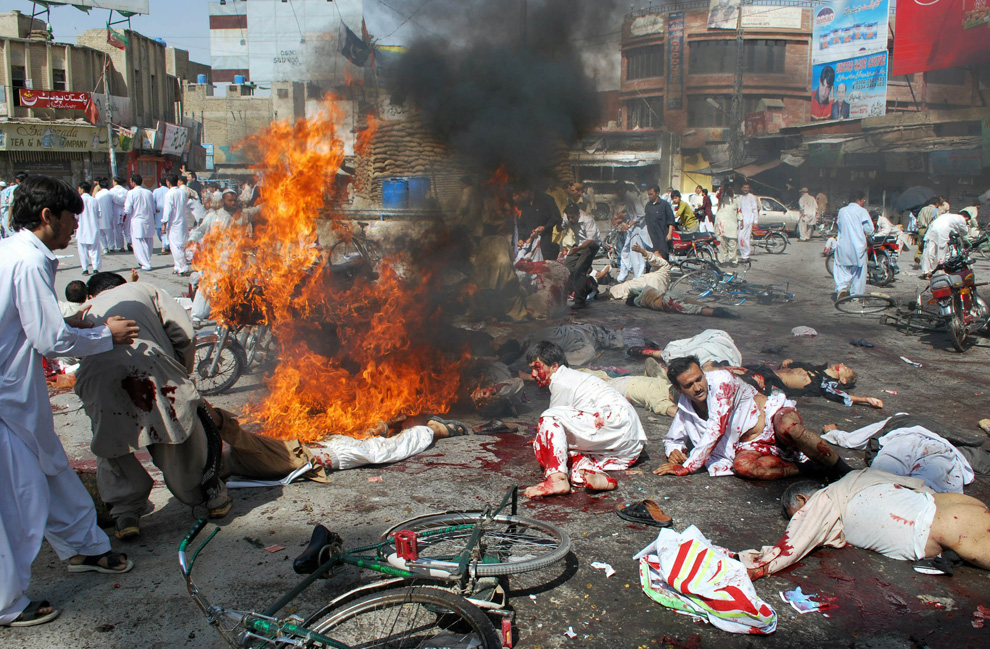
After the assassination of Salman Taseer, Punjab's governor, in retaliation for his public support for Asiya Bibi, a Christian woman sentenced to death under Pakistan's blasphemy laws, I didn't think so much as I felt. My first instinct was not to be a good academic and explain, contextualise or give nuance to the phenomenon of "extremism" or "fundamentalism." I just felt anger, and sadness, and deep confusion as to what fighting these people, or fighting for Pakistan might mean. The important thing is that I did see it in terms of a fight, a desperate struggle. For what? I couldn't say, but at least so that nothing like this would happen again. We're all conditioned, as academics, to be wary of emotional manipulation, but news report after news report of bombings in Pakistan, and gruesome photographs of dead bodies lying in the streets, can really get to you after a while. Seeing the outpouring of support for Taseer's killer - he was quite literally showered with rose petals - deepens the feeling. But I also know that by "fight" I don't mean more American drones, or a new military dictator in Islamabad, or even rallying around the banner of something called "secularism."

In August, I wrote a piece that challenged writer Aatish Taseer's vision of Pakistan. I thought that his call for Pakistan to recapture its lost "Indianness" masked an insensitivity to the country's legitimacy, and I accused him of wanting to save Pakistan without loving it. Now, reading his moving eulogy to his estranged father, I feel a bit embarrassed. Why should Aatish, born in India, raised by his mother, and largely unacknowledged by his father, feel any love for Pakistan? And how would he feel now, after seeing his father murdered by religious extremists? What right do I have to nuance his statements about the threat of the "bearded men"? But I was still right in the end. Aatish passionately believes that, "Pakistan and its founding in faith, that first throb of a nation made for religion by people who thought naively that they would restrict its role exclusively to the country's founding, was responsible for producing my father's killer." Indeed, this was the very reason father and son drifted apart. If Salman was a "Pakistani patriot," Aatish explicitly didn't believe that Pakistan should even have come into being. What room for compromise?
By itself, the statement that the idea of Pakistan was a doomed experiment from the start is not exceptional or particularly objectionable. But Aatish Taseer's solution is troubling: he wishes that "science and rationality" had been "enshrined at the heart" of the nation instead of religion. By extension, should we combat men like Malik Mumtaz Qadir (the assassin) with science and rationality? What chance do these concepts have against the powerful lure of religion; who would then shower him with rose petals?

This debate reminds me of another dead-end, the fate of state-sponsored "disenchanted" secularism in India. After the Ayodhya verdict, when a sitting judge declared he had determined the actual birthplace of Lord Ram, I experienced the same kind of reactionary despair. "To hell with academic critiques of secularism: fight this superstition to the end!" The problem is that the academics may be right. Secularism alone, and science or rationality alone, are not enough to persuade people to stop seeing themselves as having a set of religious or communitarian interests they must defend to the death.

So if we don't have secularism, and we don't want to fall back on state violence, the only thing we have left is ethics. That is to say, human-to-human, day-to-day interaction. What makes the blasphemy laws and the Ayodhya judgment wrong is not so much that they are superstitious or irrational, but that they destroy the ability of human beings - Christians in Pakistan, Muslims and other minorities in India - to live in peace, to move freely through the cities and villages, to draw water or sell their goods in the bazaars, to express themselves without fear of violence or retribution. These are not even necessarily "human rights" at a universal level. They are local and intimate affairs. With regard to Pakistan, what is most urgently needed is not advocating for science and a secular state - an agenda sure to enrage clerics and disaffected young men like Malik Mumtaz Qadir even further. It is, somehow and in a diffuse and imperceptible way, to cultivate an atmosphere where individuals look upon their neighbours with compassion and mutual sympathy. Notions like "pluralism" and "tolerance" are not political slogans; they are ethical targets for individuals to re-train their sensibilities away from conspiracy and paranoia and toward genuine understanding of the lives of others. It may sound like a naive proposition, but it's actually a realistic description of what happens almost every time individuals come into contact without mutual suspicion and violence anywhere in the world. Yes, even in Pakistan.

Thursday, 30 September 2010

The Ayodhya verdict and the burden of responsibility

Of course, the desire for peace and communal harmony is first and foremost in mind when we read the Ayodhya judgment. Of course it is better for both the RSS and Muslim leaders to urge acceptance and restraint. Of course 1992 was a long time ago.

But it is also impossible to read the verdict without feeling a sense of deep unease from an intellectual standpoint. It should be the responsibility of participants in civil discourse to ask some serious questions about what these judges have written.

http://www.outlookindia.com/article.aspx?267309

1. What does it mean that a judge unequivocally declares the site the birthplace of Lord Ram "as per the faith and belief of the Hindus" and talks uncritically of the shapeless and formless "spirit of the divine"?

2. What does it mean that a judge can now rule about whether a building is or is not a real mosque depending on whether it was built "according to the tenets of Islam"?

3. To what extent is it in the authority of 21st-century courts to construct and rule on historical fact, by using evidence from the Archaeological Survey of India and 18th century travel accounts? What is the difference between a judge and a historian?


The debate around law and "secularism" among the intelligentsia has usually revolved around questions of personal law, minority communities, and the impossibility of a neutral state administering impartial judgments without somehow engaging in political, and more importantly religious, give-and-take. In an essay entitled "Living with Secularism," written earlier in the decade as the Ayodhya case was still pending and the Archaeological Survey of India had just begun its investigations, Nivedita Menon pointed to the complicated position of "secularists" having to appeal to "unelected institutions" (the courts) to protect their values. Even if some decision were reached about temples and mosques, the real question was still what we should do about it as a democratic society? In other words, the real site of the struggle was located squarely "in the murky realms of democratic functioning."

Now that the ASI and the court have issued their decisions, we can see that the problem is actually of a different magnitude altogether. I agree, in principle, that such issues cannot be left to technocratic processes that will inevitably reveal their biases and blind spots. But what both the ASI and the court have done is to "enchant" the law and politics to a far greater extent than the opponents of "disenchantment" (like noted critic of Western-style "secularism" Ashis Nandy) could have imagined. It is not so much that the judges seemed to favour the majority over the minority, or legislate as Hindu chauvinists, though that is certainly what they did. By declaring Ram to be a "juristic person," and appealing to the inviolability of religious traditions against legal action around the world (would this have been an issue if we were talking about Jerusalem or Mecca, they asked), the judges have set a very dangerous precedent that must be combatted at once on all fronts - intellectually, legally and politically. It is no longer enough to frame the problem merely in terms of an oppressed and discriminated Muslim minority. The existence of the law, as imperfect and imperfectly secular an instrument as it may be, as a recourse available to the millions of Indian citizens, including Christians, Dalits, atheists, and all those who do not happen to believe that Ram is a juristic person, is now under threat. It may well be that we have to work to push the law back up to that position we thought it could never occupy - above religious doctrines, in that space where neither Ram nor Mohammed has any standing. Failing that, if the genie indeed cannot be put back in the bottle, if the courts absolutely must take it upon themselves to make such sweeping rulings, we should at least preserve the distinction between religious or community interests (what is good for India's Hindus and Muslims) and absolutist matters of faith. If this had been the standard, I think the ruling may have looked different.

For a sadly instructive contrast, here is an excerpt from the Telegraph about the first Ayodhya case:

"In 1885, the Faizabad deputy commissioner refused to let Mahant Raghubar Das build a temple on land adjoining the disputed structure. Das then filed a title suit in a Faizabad court against the secretary of state for India, seeking permission to build a temple on the Chabutra on the outer courtyard of the disputed structure.

His suit was dismissed on the ground that the event (alleged demolition of an original Ram temple in 1528) had occurred over 350 years earlier, and so it was “too late now” to remedy the grievance. “Maintain status quo. Any innovation may cause more harm than any benefit,” the court said."

We have not since, and could never have done, better than this.

Tuesday, 10 August 2010

"The State of Pakistan," a new genre of journalism

I don't know what it is about the piece I am about to comment on that made me finally write this post; it could have been one of hundreds of others that have appeared in print and online, from both Western and South Asian sources, over the past few years. Perhaps it is because I am so used to dismissing them as temporary effluvia from the security politics crowd lacking the requisite sense of history, but this time something in me responded to the message. This is Aaatish Taseer's recent article in Mint, entitled "Losing faith in Pakistan."
http://www.livemint.com/2010/08/06210142/Losing-faith-in-Pakistan.html

The interesting thing about this article is that it manages to be half remarkably insightful and half pernicious nonsense. Let's start with the good: Taseer's basic claim is that contemporary religious extremism in Pakistan aims to "cleanse the Islam of that country of its cultural contact with the Indian subcontinent." In practical terms, this refers to the imposition of Saudi-derived ideological puritanism and the political programme of Maududi's Jamaat-e-Islami set up against "the full world, the world of culture, of stories, of songs, of dress, of ornate ritual" epitomised by the "syncretic" Sufis. Taseer is undoubtedly right in saying that the societal conflict tearing Pakistan apart has far, far less to do with clashes of civilisations between West and East than with the largely internal political struggle over the forms public religion should take in Pakistan. Such a position compels us to understand the different fractions and cleavages within the various Muslim movements within Pakistan, as Manan Ahmed pointed out during the height of the "failed state" hysteria in the Western media, aka that "the Taliban are 20 miles outside of Islamabad" time:
http://www.chapatimystery.com/archives/homistan/just_a_thought_v.html

The recent attacks, first on the Ahmadi mosque, then on the Data Darbar Sufi shrine in Lahore, seem to have awakened even the most hopeful and progressive commentators to the existence of a very real threat. If the country as a whole is in no immediate danger of being "Talibanised," still the audacity and increasing frequency with which the attacks are coming raises the question: who is not a kafir now? Alarmism may not be such a bad word anymore. See Raza Rumi's impassioned appeal:
http://lahorenama.wordpress.com/2010/07/20/stop-lahores-talibanisation/

Taseer also very justly points out that far more of an outcry followed the Sufi attack, even among the lamenters. In the official media, of course, passing off the Ahmadi attack as a Zionist conspiracy was not only easier but also de rigueur. On the other side, with the exception of Manan Ahmed's excellent series on the history of anti-Ahmadi legislation (archived here: http://www.chapatimystery.com/archives/category/homistan), the debate is dangerously close to reproducing a "good Sufi"/"bad Wahhabi" dichotomy that has plagued the literature on Pakistan for quite some time.

One take-away point from Taseer's piece is that historians need to pay more attention to the "Islamisation" of Pakistan under General Zia and to the connections, especially via labour migration to the Middle East, between Islam in Pakistan and outside. But we should avoid imposing a dualistic frame over all past events, as William Dalrymple does when he recasts even the history of the 1857 Indian Mutiny as a struggle between the tolerant Sufis of Bahadur Shah's court and the North Indian rebel forerunners of Osama bin Laden. Such wishful thinking avoids the uncomfortable questions about Sufis' role in upholding the feudal order in Pakistan, somewhat forcefully asked in the following article with the provocative title, "The Bad Sufi":
http://www.dawn.com/wps/wcm/connect/dawn-content-library/dawn/news/pakistan/03-the-bad-sufi-ss-02

To better grasp what made me uncomfortable with Taseer's presentation of the story, I re-read the introduction to his otherwise excellent translations of Manto, where he claims that he is rescuing Manto for India out of the ghetto of being considered a "Pakistani writer." By implication he is doing the same thing for Urdu. Similar to his suggestion that Pakistan's problems could be resolved by a rapprochement with some forgotten essence of "Indianness," or as he puts it, the "Indian pink" underneath the "black Arab abaya," this claim has the air of denying the validity or legitimacy of the Pakistani nation itself. Towards the end of the article, the argument gets more and more intense, and in one sentence the problem of Kashmiri azadi is thrown away as a mere fixation of insecure Pakistanis in search of an identity -- which is remarkable, even offensive, considering the massive violence and curtailment of freedoms unleashed by the Indian Army in Kashmir even as we speak. The flavour of the month:
http://kafila.org/2010/07/10/curbs-continue-on-kashmir-media-is-it-martial-law-in-srinagar/

I am, first of all, no nationalist, and least of all a Pakistani nationalist. I have repeatedly said in various conversations on the topic that Pakistan, "moth-eaten" as it was at birth and caught in the paradox between being a "state for Muslims" that was not meant to be a "Muslim state" (Jinnah's utopian dream), divided between Punjabi elites and waves of regional separatism from Bengalis to Balochis, crushed by the army and the centre, has had a sorry run of historical luck. But all that has been over the past 60 years, sab ho gaya and we cannot un-wish Pakistan out of existence. Every single time a Western or Indian commentator suggests that Pakistan is facing an "existential" crisis and goads this enormously diverse and stratified population to breezily "re-think" the basis of their country and to learn "new narratives," the implication remains that the people of Pakistan are somehow a "problem people," engaged for over half a century in the illicit enterprise of having a country. History can't be re-written overnight; as Marx once wrote, "Men make their own history, but they do not make it as they please." In Pakistan's case, the fight for social justice, democracy, and pluralism can only start from the rubble around us, brick by brick. It might also have to happen under the same green-and-white flag at the end of the day.

Ayesha Jalal began her Manzur Qadir Memorial Lecture of 1989 in Lahore, by saying that she loved Pakistan "with the same complicated and consuming passion" with which Braudel loved France. The problem with most of the purveyors of the "State of Pakistan" brand of journalism in India and the West is that they wish to save Pakistan without ever having loved it, at least a little bit.

Monday, 28 December 2009

That Was the Revolution That Was: 1989 at 20

In post-communist Romania, history repeats itself as farce every winter, when talking heads and gray beards congregate on television to re-hash, ostensibly as a form of public service, what exactly happened in 1989. The stale, hours-long "debates" revolve around a set of questions that are both uninteresting and ultimately unanswerable, when those with the most at stake in covering up the truth are the ones being asked. First, there is the "coup d'etat vs. popular revolt" dichotomy, with its faithful subplot: the degree of outside involvement, mainly Gorbachev's and the KGB's. Second, the admittedly important problem of the mysterious "terrorists" whose rumoured presence in the capital led to thousands of deaths. Third, a more expansive chronology argument: was the revolution "stolen," and if so, when and by whom? What were its precise turning points, and how did contingency and conspiracy interact?

Not all of these lines of inquiry are relevant; indeed, keeping the focus on these mostly superficial formulations has allowed Iliescu & co. to spin a lot of yarn in weaving a veil of deceit over an exhausted public's eyes. Every so often, someone comes out of the woodwork claiming to hold the key to the whole highway; this year, it was Gen. Victor Stanculescu, former defense minister during the revolution and immediately after, now in prison for giving orders to shoot before his miraculous conversion to the revolutionary cause. He claims it was all a Soviet plot, and the "terrorists" were partly KGB agents. Provocative, and virulently anti-Iliescu on the surface, yet still not the story. Too much agency is handed over to the best-laid plans - for historians, this cannot do.

The long-term dynamics of Ceausescu's fall are not hard to track: since the 1970s Iliescu was his anointed heir, and his long exile in the wilderness proves the old man was aware of the danger. The "Letter of the Six," reformist communists who in March 1989 publicly challenged Ceausescu, represented but a small opening in the shifting tectonics of Party structures under the Leader. Indeed, the crucial question that no one directly asks the eminent revolutionaries is how and why were they so ready to form a new government hours after Ceausescu's flight? Where did Iliescu and the FSN (National Salvation Front) come from? Such a body does not form overnight; instead, it had probably been busy consolidating itself for most of the 1980s, making connections and building up support. The Letter was a kind of testing of the waters, and Ceausescu's loyal Securitate elements were quick to repress; yet who knows how much of the apparatus was quietly shifting its loyalties? As for the Soviets, they did not need to directly intervene. Gorbachev was certainly against the hard-line regimes of both Ceausescu and Honecker, personally and politically. He saw his own attempts at reforming socialism stymied by the intransigence of Moscow's old-style erstwhile allies. Iliescu's own penchant toward a perestroika-type society is well documented. Believing Ceausescu to have "sullied the ideals of socialism," the FSN was confident at first in its public proclamations to appeal to a vision close to Moscow (and even, in a telling but brief moment, to direct Soviet military support). Gorbachev's silent policy of non-intervention emboldened the growing second-rank communist movement that became the FSN to act; they waited for their opening and seized the day in December '89. They did so because they were convinced that the country was doomed under the status quo, that socialism had to be saved - in this they were close to Gorbachev's ideas. Yet Ceausescu himself held on to a hard-line position for the very same reason, and was paradoxically proven right by history. Once the iron grip was loosened, the game was up and socialism did crumble. Perhaps no one was more aware of the fragility of the regime, both economically and politically, than Ceausescu in his final days. His stubbornness was the sign not of a man who had lost the plot, but simply of one who had run out of options. This also explains his summary trial and execution, by any account a clear perversion of justice. Iliescu & co. tend to stress the necessity of such a move to "reassure" the population in those heady and uncertain days. While this may have been true, what did Ceausescu know and say publicly about those who had pulled the rug out from under him? The point is, we'll never find out. In the end, Soviet involvement is a great canard. Gorbachev may not have even foreseen or approved of the events of 1989 as they unfolded, but he certainly enabled and inspired them. The revolution was neither a coup nor a popular uprising, but a structural re-aligment: a complex, factional transfer of sovereignty involving different elements of party cadres, the Securitate, and the army. The only certainty is that the FSN was left standing as a solid, powerful entity with the will, capacity and legitimacy to govern as 1990 began.

On the second question of the "terrorists," there are many competing theories, ranging from KGB agents to loyal internal Securitate men to, well, nobody - merely a confused population who had been given arms to defend itself against an invisible enemy and had ended up shooting each other. A bombshell revelation, if it were to help resolve anything, would be needed here. But it may not matter all that much, despite the horrific death toll. It seems callous to say, but the greatest tragedy of the revolution has been the seeming irrelevance of its victims' sacrifice. For what did people die in the streets of Timisoara and Bucharest? Violence was a manifestation of a moment of suspended sovereignty, a kind of state of exception (where would we be without Agamben and Schmitt?) that allowed the new structures of power to consolidate. The price of the new regime was exacted in blood, not once but several times until the end of the following year.

If there was indeed a true opening for revolutionary action, it was not in the confusion of 1989 but in the growing discontent of 1990, when breakaway elements of the FSN -mainly former dissidents- and returned expatriate parties staged protests against Iliescu's decision to contest the first elections. This led to the infamous mineriads, when Iliescu repeatedly called on miners to march on the capital and beat up the "intellectual" protesters, condemning them as fascists and foreign agents. We are not necessarily dealing either with a genuine popular revolution that was "stolen," nor with an all-powerful coup methodically eliminating its enemies. Indeed, the extraordinary and naked violence of the mineriads, conducted unashamedly and out in the open (unlike 1989), should be read as a recognition by Iliescu's FSN of its limits: a serious crisis of incipient sovereignty. Provoking violent inter-class conflict was the only language with which Iliescu could face this challenge. The story since, wherein by 2009 Iliescu is an elder statesman and ex-FSN members form the backbone of all the major political parties left standing, does make a rigged game seem like the most logical frame. The answer is more subtle. Most remarkably of all, the structures of power put together by second-rank communists in the 1980s were able to outmaneuver both Ceausescu and the few dissident voices from the other side and creatively respond and adapt to the events of 1989-90, including the overthrow of the communist system (which they may not have anticipated, at least so suddenly) and electoral politics, to constitute themselves into an ever-expanding and tightening oligarchy. Such an analysis takes both contingency and large-scale determinants into view, stressing their mutual influence and constitution.

Historians of Romania (I am not one of them, though I could be considered a Romanian historian) face two urgent and monumental tasks in the years ahead. The first, to re-write the history of the revolution "from above," namely: working with Romanian and Soviet archives to trace the relationships between the Ceausescu regime and the outside world; assessing the strength of party structures in the 1980s, especially the development and internal conflicts of different Securitate and army factions - a utopian project, at least until Iliescu and his acolytes are dead or significantly marginalized; above all, explaining how the FSN and other forces became revolutionaries against, and heirs to, Ceausescu's regime. A range of methodologies, from diplomatic history to economics to political science approaches, would have to all be applied in concert. The second angle would make progress on the revolution "from below," namely establish a comprehensive history of popular protest against communism and its effects. One mostly neglected subject of research is the 1987 Brasov workers' revolt, one of the most important moments of resistance against the state. It is not enough to argue for simple causality or prefiguring, nor is it plausible to suggest that people ventured out into the streets out of the blue for the first time in 1989. The successes and failures of these movements, as well as their connection to the institutional story told above, must be carefully built up from still-restricted official documents and popular memory. Indeed, a great work on the genealogy of popular protest under communism going back to the mountain fighters of the early 1950s still remains to be written. Romanian historiography needs its own Ranajit Guha to write an Elementary Aspects of peasant and worker insurgencies. The day when all these levels of analysis can be integrated into a definitive account is far off, and may never come if political conditions in Romania remain as unfriendly to serious historical thinking as they are today.


*FURTHER READING:
The exhaustive blog of tireless researcher Marius Mioc collects video recordings, transcripts, and many other sources on the revolution and is a good place to start piecing it all together:
http://mariusmioc.wordpress.com/
See also Richard Andrew Hall's excellent dissertation:
http://romanianrevolutionofdecember1989.wordpress.com/

Thursday, 12 November 2009

The Lesson of Gujarat, or How to Talk about Events

That the recent tragedy at Fort Hood should raise the spectre of anti-Muslim hysteria in the U.S. is by now commonplace. But the real stakes of the debate, namely the precise consequences of a certain way of thinking about events and their repercussions, are obscured by placing the focus of the debate around "how much Islam has to do with it." Framing the shootings of U.S. servicemen by this individual Hasan in the language of "terrorism" or "Islamic fundamentalism" is undoubtedly problematic. But to respond, those of us who wish to re-frame the issue are inevitably forced into a kind of obscurantist cul-de-sac that allows no discussion of Islam or Muslims whatsoever: that this is an isolated act of a "mentally unstable" person, that religion has "nothing to do with it." What we grapple with, in essence, is the singularity of the act and its relationality to a wider field of discourses, or ways of talking about things (in this case, Islam and Muslims).

Here is what I mean: whenever such events occur and are disseminated through the media, as they inevitably will in our globalised age, we should avoid the temptation of seeing them as exceptions, as acts that stand alone in the world, infinitely contingent. Instead, we should accept from the start that they will immediately feed into a vast discursive terrain of things being said, worked out and worked over, about macro-categories we are uncomfortable with, yet ignore at our peril. We should follow this event through the discursive terrain and see where it lands, and thus make visible the consequences of its particular path. The relational consequences of singular events are often so jarring that they might yet enable many (with the exception of those who are willing to pay the price), to look at the terrain anew and be made aware of the treacherous channels through which information travels and is re-directed, of how events acquire meanings.

I will use the example of the 2002 Gujarat massacres to make my point. Here, a much-disputed and yet very "real" event, the burning of 58 Hindus in a train coach in Godhra, happened in all its garish and horrifying singularity. Whether it was deliberate arson by a mob or something else, whether the categories of Hindu victims and Muslim attackers should be deconstructed, are all important yet tangential issues. Trying to disentagle religion and politics, local contexts and broad phenomena etc. etc. from the charred remains of this event, though ethical and honest in a scholarly sense, is mere impotence in the face of what happened next, when as many as 2,000 Muslims were massacred while the state not only stood by, but actively aided and encouraged the violence. A confrontation between certain individuals at a certain point in time was a spark to a fire that burned along the axes of Big categories, "Hindu" and "Muslim," all across Gujarat. In Amitav Ghosh's novel The Shadow Lines, the traumatic riots in Calcutta and Dhaka of 1964, which so decisively shape the characters' lives, can be traced back to an incident in far-away Kashmir over a stolen relic. Singular events become relational to contexts far distant in time and place. If we have a truly political, indeed moral, task in our complicated world, where information travels at once faster and more insidiously than ever, it is to break the links that are formed in this way.

What would it mean to think of Godhra, minutes or hours after it happened, with the bodies of 2,000 innocent people in mind? What would it mean to follow the contention that an individual Hasan stands in for a "Muslim problem" that must be faced, to its logical conclusion, to a widespread and concerted effort by individuals and the state to "deal" with it? The consequences of thousands of lives lost when so many minds are fixed (or being fixated) onto a category, in this case of the problematic Muslim that must be dealt with, are not worth the mental leap. There are those who will say that such violence is the inevitable result, or collateral damage, of whichever side they think is to blame acting wrongly. Yes, 2,000 Muslims died, but that's because they started it. This is, I would hope, only a small minority of those who are engaged in the conversation. The task for scholars, activists, and all of us concerned about these issues is to show that the price to pay, of creating a climate for civil violence, is far more de-stabilising to the security and internal peace of communities than a singular act unavenged, or a problematic category not properly dealt with. This is especially true in the United States, where the potential for reprisals is always high yet, with almost no exceptions, since September 11th no serious and sustained civil violence has occurred. India's lessons, from the Sikh massacres of 1984 to Gujarat and on, are vital in this regard. Communal bloodshed on general lines, visited upon individuals whose only connection to singular events from another place and time lies in the relation with those events constructed in people's minds, is a price too steep to ever pay. To suppress this urge to relate the singular, to think of unrealised consequences instead of the real and visceral event that has just happened, is admittedly difficult but it is also urgent.

Saturday, 22 August 2009

The Trouble with Jinnah

On this topic, I will live up to the blog's title (which, by the way, is only 10% a pun based on the assumption that what I have to say is "just," and 90% straightforward, as in an honest admission that what I am offering is merely speculative). I don't know much about Pakistan, even less about Jinnah, and nothing at all about senior now-ex-BJP politician Jaswant Singh's new book on Jinnah that has caused so much controversy, because I haven't read it. From what I've heard, he has proposed that Jinnah was a sincere nationalist with a liberal, secular vision for Muslims whose best efforts at maintaining a united India were stymied by the intransigence of Congress leaders Nehru and Patel. Much has been made of the fact that such an argument at once united Congress and the BJP in outrage, and Narendra Modi banned his book in Gujarat not because he praised the creator of Pakistan but because he insulted the Gujarati hero Patel!

Why would a senior BJP leader praise Jinnah? For that matter, why did L.K. Advani, cheerleader of the Babri Masjid demolition and current head of the party who expelled Jaswant Singh, get into similar trouble four years ago for travelling to Karachi and saying nice things about the Quaid-e-Azam of Pakistan? The easy answer is that Jaswant is a "moderate liberal" member of the BJP who has always been interested in better relations with Pakistan, also the momentary goal of Advani on that particular trip. We can note that Singh is a scholar with a genuine interest in history who simply couldn't deny a valid explanation of Partition based on evidence (his points are not new in the literature, having been first articulated with great force and originality by Ayesha Jalal in her 1985 book The Sole Spokesman). But is there a Hindu nationalist case for Jinnah? What rhetorical moves can be made to arrive at such a position?

Here I want to repeat that I am not speaking of Jaswant Singh's beliefs per se, since I haven't read his book and don't want to put words into his mouth. He may very well be a liberal man who simply wants to build bridges; I wish to perform an imaginative exercise that would explain how Jinnah fits into a certain kind of Partition narrative.
Let's start with the fact of the division itself. The RSS and BJP have forever been utterly opposed to the very idea of Pakistan's existence. Indeed, one of the things that got Advani into hot water after he came back from Karachi was his assertion that Partition was "irreversible" and should be accepted. I read this statement, together with his comments about Jinnah being secular, as deeply melancholic. The old RSS man Advani is saying, "I don't like the fact that this country exists, but we have to deal with it, and anyway if it should have existed in the first place it would have been better off under secular Jinnah than as it turned out."
What Hindu nationalists don't like about Pakistan as it exists today is 1) its perceived Islamic fundamentalism (they obviously oppose the very notion of an Islamic state, and the threat of terrorism hangs heavy on their minds) and 2) its militarism (they perceive Pakistan not as a neighbor but as a permanent adversary). The distinction of an Islamic state vs. a state for Muslims is a subtle one, and for the average Hindutvavadi there may be no difference. For a sophisticated thinker like Jaswant and even for Advani, the "secular" promise of Jinnah, which included protection of Hindu minorities in Pakistan (Advani is a Sindhi Hindu born in Karachi), is a counterpoint to what they see as today's dangerous Pakistani state. The trick is that Pakistan itself is a story of failure, a grievous error that has ended badly for everyone (but especially for Hindu India, which now has to deal both with a problematic Muslim minority and with a troublesome Muslim state, two if you count Bangladesh). Where this Hindu nationalist thought differs from a liberal Pakistani intellectual in lamenting the difference between Jinnah's vision and reality is that, while it prefers Jinnah's secular Pakistan to actual Pakistan, the best thing of all would have been no Pakistan.

Here the second interesting twist happens, involving the attack on Nehru and Patel. Jaswant Singh himself has asked, "What part of the ‘core belief’ has been demolished by my book? What is core about Patel? He was the first leader to ban the RSS and imprison its leaders...but he didn’t ban the Muslim League.” This is perhaps the most un-subtle yet overlooked aspect of the whole story. The BJP in all its incarnations over time, from the BJS to the Janata Party, has first and foremost been suspicious of Congress-walas. To rehabilitate Jinnah is to redistribute the blame for Partition unto Nehru and Patel's shoulders, men who were actively hostile to the "right" kind of Hindu nationalism. After all, they were the ones who "let" the country fall apart and didn't "deal" with Jinnah properly.

To sum up, the feeling one gets is that there is a strand of Hindu nationalist thought that wishes more was done to prevent the creation of Pakistan, though at the cost of keeping more Muslims within a united India. This seems paradoxical, since the Hindu right has been trying for years to intimidate, and sometimes violently suppress, Muslims in India. But deep in the psychological recesses of that hateful chant aimed at the Indian Muslim, "Go to Pakistan!" lies this very frustration with India's division. "You have your state," they are saying, "now go to it."
What would have been the fate of Muslims in a united India? Do Hindu nationalists who oppose Partition believe they would have been swamped by numbers or "kept down" in their appropriate place?

More importantly, from "our" perspective (as scholars concerned with minority interests), how should we interpret the creation of Pakistan from the standpoint of what should be, in my view, the all-important question: what was/is best for Muslims in the Indian subcontinent? On the one hand, we decry Partition and its loss of life, and may wish that Muslims could have found a place in a united, secular India. But then what of Pakistan's intended purpose, as a safe space for Muslims? In the 1973 film Garam Hawa, Balraj Sahni's character is an aging Muslim shoemaker living in Agra who sees his family gradually disintegrate and, shunned, disempowered, even physically attacked at home, decides to make the move. The director, M.S. Sathyu, ends the film with the character changing his mind and staying in Agra to participate in a protest march. The conclusion affirms the possibility of a secular, socialist future in India that includes Muslims, and Sathyu never shows what happens on the other side of the border. Here Pakistan can appear as an option, a refuge from worsening conditions for Muslims in India. But the plight of the muhajir in Pakistan, as well as that country's turbulent history more generally, question such an assessment.
Pakistan is therefore a difficult subject for the historian, and there is no final verdict that can be rendered on a country so large and complex. Does it even make sense any longer to view Pakistan through the lens of "Muslims as a whole in the Indian subcontinent?" Separated by years of violence and miles of barbed wire, are Pakistani Muslims and Indian Muslims now two separate entities, like two species of Darwin's finches evolving on adjoining islands?

Saturday, 4 July 2009

The Empire Debate: Thinking at an Angle


I may be seven years too late on this one. In the months after 11 September 2001, when the United States had finished bombing Afghanistan and was gearing up for another round in Iraq, the word "empire," with its many meanings, past, present and possible, was seemingly on everyone's lips. When Donald Rumsfeld caustically stated, "We don't do empire," the floodgates were opened and historians poured into the breach. The historical balance sheet of previous empires, which almost exclusively meant our apparent predecessors the British (with a few token references to the schoolboy debater's favourite retreat, the good old Romans!), were furiously calculated from both the Left and the Right with a view to answering a surprising question: not merely whether empire was good or bad, but should the United States become one? And if it was one already, should it continue, or even try harder, to be one?

The arguments against the position that the U.S. has an imperial role to play in today's world have been made ad nauseam, and I have no intention of repeating them here. They usually involve a simple rhetorical tactic: directly rebut the apologists' claims that previous empires (read: the British) had done "good things." Thus, the critics started listing a whole lot of "bad things," from famines to massacres to institutionalised racial and economic discrimination. This calculus went back and forth until the only thing a reasonable person who hadn't yet made up their mind about this could conclude was that empires had done both good and bad things, and picking a side was by and large a question of political preference.
An altogether more interesting thing to do is to take the imperial apologists' claims at face value and see how they measure up to their own promises; in other words, to dissect the internal logic of the argument itself.

Summarised quickly, the "good things" the British Empire gave to the world include economic development (the shining example being India's railroad system), parliamentary democracy (plus the rule of law and notions of citizenship and liberty), and some cultural fun stuff like the English language and team sports (cricket). All of these things make it easy for countries like India to be part of a modern, globalising world. Now, if we agree that this is indeed good, the question then becomes, what is the role of empire in the process?
One ingenious critique of the idea of empire was suggested by Amitav Ghosh in the essay "Imperial Temptations," published at the height of the debate in 2003. Empire as a way of bringing good things to the world was bound to fail because it "cannot be the object of universal human aspirations." In other words, not everyone can have an empire, which relies on a permanent hierarchy of ruler and ruled. Ghosh says the idea of a nation-state, whatever its failings, at least holds a generalisable promise: that everyone, everywhere, can be a citizen with equal rights in his or her country. He also points out that empires tend to inevitably expand, leading to overreach and conflict. This is a useful rebuttal to the notion that the U.S. should be the world overlord lest we all descend into a Dark Age of petty squabbling states; instead, hegemonic U.S. power is likely to strain its own resources and give rise to a host of competitors large (China) and small (various terrorist networks and rogue states) all striving to bring down the giant. Perhaps this point has only become clearer since 2003.

But even if empire is a rotten way to get it done, what of those good things? The internal logic of the argument "Empire brought good things therefore empire is good" is fundamentally flawed for a simple reason. All those good things can be fully enjoyed only after the empire is gone! For example, Indians can use their railroads today because the British are no longer there to impose the many restrictions they were built under. Saying this is not necessarily agreeing with the "drain of wealth" theory. On balance, however small the advantage, it's better for Indians to use all the railroads for their own purposes all of the time. Next, parliamentary democracy. Only after a political independence movement that created a separate nation can Indians have constitutions and elections. And so on, until we are left with only cricket (and maybe not even that, considering how deeply Indianised the sport has become).
The conclusion here is that empire needed a powerful counter-force (for example, anti-colonial nationalism) to dissolve itself and spread its good things to the very people it had meant to help all along. An apologist could counter that the British Empire was not brought down by nationalism but by its own weakness and lack of will. Thus, if India and the rest were colonised some more, perhaps a few more decades or centuries until all the good things were in place, the empire could have left of its own accord and its subjects would be better off. This ignores quite forcefully the last thirty or so years of the British Empire: political reforms in India, for example, were not handed down smoothly according to some beneficent master-plan but fought for tooth-and-nail by nationalists (who realised themselves only after many years and internal squabbles that they wanted to be independent). The point is that nobody knew when the end would come, let alone planned it. Without resistance of any kind, it is conceivable that the British Empire would have gone on forever with less of the good things and more of the bad.
This brings me to the final nail in the coffin of the pro-empire argument. Frederick Cooper has brilliantly written in his book Colonialism in Question that when the British and French empires "tried to make themselves more forward-looking economically and more legitimate politically, they could not face the escalation of claim-making their actions encouraged, the tensions that followed from their economic interventions, and the high cost of making an empire meaningful as a unit of belonging." In other words, when empire tried to bring more good things it found the demand so overwhelming it had to give it all up fast. Or, as I've put it above, empire required its own demise to complete its mission, which means that empire is ultimately unable to do the job.

There is one more line of reasoning that could yet salvage the empire: counterfactuals. If empires are doomed to fail, is it not better that we had them for a while, considering the alternatives? Wasn't the British Empire better for its colonies than the German or the Russian? Here there are multiple confusions and nuances. First of all, critics do not condemn the British Empire because it was British but because it was an Empire. The very phenomenon of European imperialism is in question. Secondly, it follows that we cannot imagine a scenario in which only the British would not start an empire. A reasonable historical counterfactual would instead suppose that if one European power did not expand, neither would the others. The conditions that gave rise to imperialism (technological progress, maritime exploration, the interconnected European economy with its industrialising tendencies) gave rise to many empires, often because of competition with each other (i.e. the British became powerful in the late 18th century in large part because they had overtaken the Dutch, then the French). Indeed, as Amitav Ghosh reminds us, if the mark of success for a nation is having an empire, then all nations who aspire to success will want one.
The only counterfactual that remains is, if Europe had not expanded, would the rest of the world be better off evolving on its own, India going forth from the Mughals and so on. This question is impossible to answer, because modernity and empire happened to have progressed together. England in the 18th century, if you didn't know what the future would bring, was not a much better place to live in than Mughal India. And when living conditions and economic development and all that began to improve, they did so in metropole and colony at the same time, to the disadvantage of the colonies. Scholars dreaming up "alternative modernities" can do so at their leisure. Like it or not, the modern world and empires are inseparable. It only remains to be seen if this still holds true.

Sunday, 28 December 2008

Democracy and Popular Protest in India


Perhaps the most remarkable outcome of last month's attacks in Mumbai was not the sudden realisation by many in the West that India, as the world's largest democracy, was an ally worth standing by far more so than our friend for so many decades, Pakistan. There are serious questions on a large geo-political scale that need asking, but they are part of the ebb and flow of statecraft in South Asia and will not find easy answers soon.

No, what is downright amazing is a less-reported story that, following a wave of popular protests over the handling of the attacks by the Indian government, the Home Minister and national security adviser resigned. The BBC says "hundreds of people took to the streets" in a show of demanding accountability for the government's failure to protect its citizens:

http://news.bbc.co.uk/1/hi/world/south_asia/7757122.stm

Reading this story from the U.S., where the parallel with 9/11 has been pushed repeatedly by an unimaginative media, one is struck by the incongruity of such a response: after all, when their country was attacked, why did Indians not rally around their leaders and give Manmohan Singh a 90% approval rating, as George W. Bush was honoured seven years ago? The answer lies, shockingly for Westerners accustomed to believing that their variant of "democracy" is the highest stage of political development, in the truly substantive nature of Indian democracy. The Indian public sphere is not content to shore up the establishment in a show of good faith and solidarity, as the docile and ill-informed American public did. No, the supposedly flawed and backward Indian democracy produced a textbook response to the failure of its government. Where were the masses of people in the streets demanding to know what the Bush administration knew, and did, about terrorism in the year before 9/11? Why was that infamous P.D.B. of August 2001 entitled "Bin Laden determined to strike inside the U.S." not burned in effigy by angry mobs on the streets of New York, Cleveland, and Omaha? And why, if Bush and his national security team presided over the most devastating attack on American soil in history, were they furthermore given carte blanche on their judgment in starting a war?

The answer lies in different traditions of democracy in the U.S. and India, indeed in the differential basis of the nation-state. The U.S. government is an entrenched and hegemonic apparatus that presides over an apathetic and generally politically uninvolved consumer society. In India, as Dipesh Chakrabarty has brilliantly pointed out in a recent essay entitled "
'In the Name of Politics': Democracy and the Power of the Multitude in India," traditions of popular protest by workers, peasants, and other marginalised groups survive from the early 20th-century struggles of the independence movement to challenge the nation-state. Nehru was opposed to any kind of "unrest," believing it to be incompatible with a "civilised" and mature democracy (where tamer forms of accountability like petitions and the ballot box should prevail). Of course, what the nationalist elites continually failed to understand about the character of the Indian nation was the vast spectrum of minority interests found within it that could not be cajoled, appeased, or integrated without a painful process of adjustment (in other words, that hegemony was hard to come by). In all, this adds up not to a backward and unruly system but to a rich, vibrant, and relevant sense of democracy in India, which should give skeptics about India's future at least some consolation in these dark times.

Tuesday, 19 August 2008

Saakashvilli's Gamble, Or We Are Not All Georgians Now

There is an odd sense of deja vu about the Russia-Georgia War that takes us back not ten years to the obscure Balkan violence of Bosnia and Kosovo but twenty years to the Era of Big Statements, to Afghanistan, "Evil Empire," and "tearing down this wall." The phrase "Cold War" is on everyone's lips, and in the West the old rhetoric has been dutifully dusted off by sanctimonious warriors like John McCain, who declared, echoing the post-9/11 solidarity other nations expressed towards America, "We are all Georgians now." This is patently disingenuous, since McCain, Bush and the U.S. military have no intention and no way of defending Georgia with anything more than words.

Of course we should all be concerned about Russia, and no one likes Putin's authoritarian streak and the revival of Red Square parades. But this is not about Putin or Russia, who has been playing its hand in a familiar scenario on its borders for a long time now. The story is Saakashvili's gamble and the hapless role the United States played in this foreign policy trainwreck. The article below, by a Moscow-based correspondent for the Atlantic, lays it out with startling clarity:

http://www.theatlantic.com/doc/200808u/georgia-russia-war

This war is, to boil it down to the very essentials, about a very old piece of shrewd realpolitik. Stalin's redrawing of boundaries to include disparate ethnic minorities (like importing Russians into Moldova and, in this case, separating Ossetia into two provinces, one inside Georgia and the other inside Russia) ensured that nationalist aspirations would always stumble on internal conflicts. The situation on the eve of this war-du-jour was like that in many other places: a tense stand-off between the Russophile Ossetes and Abkhaz and a brash, ambitious and Western-backed Georgian leader. This prophetic travel journal from a Slate correspondent only a few months ago gives an impression of what life was like before the tanks started rolling in:

http://www.slate.com/id/2197134/entry/2191589/

Saakashvili, whose human rights record has been unimpressive since the Rose Revolution swept him into power in 2003, ostensibly as a beacon of freedom in a lawless region, was emboldened by the Americans' rhetoric of promoting democracy etc. He gladly committed Georgian troops to assist in the invasion of Iraq (an irony that makes Russian propagandists salivate) and expected a commitment in return. Not McCain's vacuous pronouncements or humanitarian aid, but concrete help, a NATO bid and commitment from the West to keep the Russians at bay. When he finally moved for endgame and attacked, he was bitterly surprised to find that he had been let down and lashed out at his erstwhile American friends. Where were they now, when it counted, he wondered as his country burned.

I have a humble suggestion for Saakashvili and for others like him, trying to walk the tightrope of 21st-century geopolitics. They should watch a small film that came out of Romania in 2007 to win a prize at Cannes. California Dreamin' tells the story of a group of American soldiers on their way to Kosovo who are stopped in a small Romanian village in the middle of nowhere. At once the locals try to use the Americans to their benefit: the workers go on strike, the mayor wants to befriend them as leverage against a corrupt gangster, and everyone remembers how, for 50 years, the Americans were always going to "come and save us," from the Nazis, the Russians, and from themselves. Better late than never, right? But all the Americans are interested in is passing through, and they do so as soon as they can, leaving behind the villagers to tear each other apart.

http://www.youtube.com/watch?v=BG21tT2eE2w

The lesson is not easy to follow, and Bush/McCain's assurances were all too tempting for Saakashvili. What we are left with is a ruined country, a bellicose and unstable Russia, thousands of deaths, and the same tired, hollow threats and promises.