Showing posts with label thoughts. Show all posts

Thursday, 13 January 2011

After Salman Taseer: Follow-up on Secularism and Despair

One of the nicest things (as well as one of the most terrifying) about having a blog is the opportunity to see your thoughts frozen in time and be able to return to them later, thinking either, "Wow, that was smart" or "I'm a complete idiot." This has happened several times since I started writing in the summer of 2008, when I was not yet a senior in college, and into my second year of graduate school where I am today. Sometimes I looked like an idiot: after my first trip to India, I expressed surprise an Indian Muslim might idolise Subhas Chandra Bose (talk about a blinkered "communalist" perspective on life). Other times I was prescient even when I didn't know what I was talking about: without a real insight into caste politics, I got a sense of the peculiar bind many observers feel when attempting to analyse Mayawati. After living in Lucknow for a summer and reading more, I realise I was right in thinking there is no one answer, even among the different Dalit visions of politics. Some (like Christophe Jaffrelot) will largely applaud her for making Dalits visible and challenging the very real caste power structures at work in her state. Others, including some radical Dalit critics, might see a surrender to the lure of the state as an instrument of policy and a failure to focus on development and social issues at the expense of symbolic ones.
My point is, I've rarely been tempted to edit myself or take down old posts because a blog, unlike official academic writing, can serve as a freer and more experimental venue to work out ideas. Especially when no one reads it!

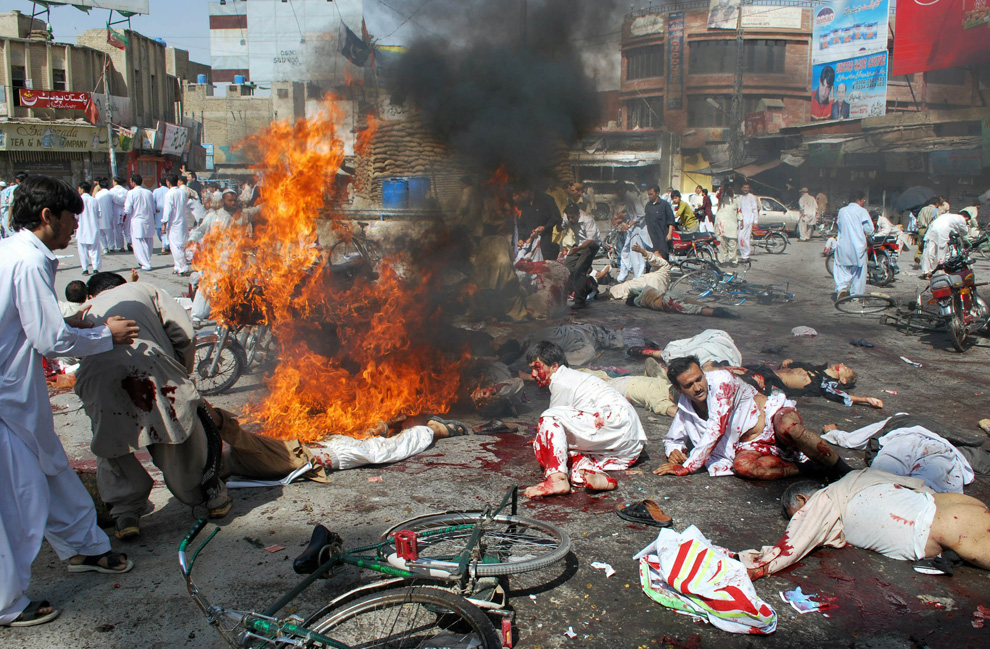
After the assassination of Salman Taseer, Punjab's governor, in retaliation for his public support for Asiya Bibi, a Christian woman sentenced to death under Pakistan's blasphemy laws, I didn't think so much as I felt. My first instinct was not to be a good academic and explain, contextualise or give nuance to the phenomenon of "extremism" or "fundamentalism." I just felt anger, and sadness, and deep confusion as to what fighting these people, or fighting for Pakistan might mean. The important thing is that I did see it in terms of a fight, a desperate struggle. For what? I couldn't say, but at least so that nothing like this would happen again. We're all conditioned, as academics, to be wary of emotional manipulation, but news report after news report of bombings in Pakistan, and gruesome photographs of dead bodies lying in the streets, can really get to you after a while. Seeing the outpouring of support for Taseer's killer - he was quite literally showered with rose petals - deepens the feeling. But I also know that by "fight" I don't mean more American drones, or a new military dictator in Islamabad, or even rallying around the banner of something called "secularism."

In August, I wrote a piece that challenged writer Aatish Taseer's vision of Pakistan. I thought that his call for Pakistan to recapture its lost "Indianness" masked an insensitivity to the country's legitimacy, and I accused him of wanting to save Pakistan without loving it. Now, reading his moving eulogy to his estranged father, I feel a bit embarrassed. Why should Aatish, born in India, raised by his mother, and largely unacknowledged by his father, feel any love for Pakistan? And how would he feel now, after seeing his father murdered by religious extremists? What right do I have to nuance his statements about the threat of the "bearded men"? But I was still right in the end. Aatish passionately believes that, "Pakistan and its founding in faith, that first throb of a nation made for religion by people who thought naively that they would restrict its role exclusively to the country's founding, was responsible for producing my father's killer." Indeed, this was the very reason father and son drifted apart. If Salman was a "Pakistani patriot," Aatish explicitly didn't believe that Pakistan should even have come into being. What room for compromise?
By itself, the statement that the idea of Pakistan was a doomed experiment from the start is not exceptional or particularly objectionable. But Aatish Taseer's solution is troubling: he wishes that "science and rationality" had been "enshrined at the heart" of the nation instead of religion. By extension, should we combat men like Malik Mumtaz Qadir (the assassin) with science and rationality? What chance do these concepts have against the powerful lure of religion; who would then shower him with rose petals?

This debate reminds me of another dead-end, the fate of state-sponsored "disenchanted" secularism in India. After the Ayodhya verdict, when a sitting judge declared he had determined the actual birthplace of Lord Ram, I experienced the same kind of reactionary despair. "To hell with academic critiques of secularism: fight this superstition to the end!" The problem is that the academics may be right. Secularism alone, and science or rationality alone, are not enough to persuade people to stop seeing themselves as having a set of religious or communitarian interests they must defend to the death.

So if we don't have secularism, and we don't want to fall back on state violence, the only thing we have left is ethics. That is to say, human-to-human, day-to-day interaction. What makes the blasphemy laws and the Ayodhya judgment wrong is not so much that they are superstitious or irrational, but that they destroy the ability of human beings - Christians in Pakistan, Muslims and other minorities in India - to live in peace, to move freely through the cities and villages, to draw water or sell their goods in the bazaars, to express themselves without fear of violence or retribution. These are not even necessarily "human rights" at a universal level. They are local and intimate affairs. With regard to Pakistan, what is most urgently needed is not advocating for science and a secular state - an agenda sure to enrage clerics and disaffected young men like Malik Mumtaz Qadir even further. It is, somehow and in a diffuse and imperceptible way, to cultivate an atmosphere where individuals look upon their neighbours with compassion and mutual sympathy. Notions like "pluralism" and "tolerance" are not political slogans; they are ethical targets for individuals to re-train their sensibilities away from conspiracy and paranoia and toward genuine understanding of the lives of others. It may sound like a naive proposition, but it's actually a realistic description of what happens almost every time individuals come into contact without mutual suspicion and violence anywhere in the world. Yes, even in Pakistan.

Thursday, 27 May 2010

Thinking About Marina


If performance art is supposed to disturb or otherwise unsettle, then the aftershocks of seeing Marina Abramovic's retrospective at MOMA
can only imply, a job well done. I am not talking about what a quick scan through the press coverage reveals to be the main issue of the day: whether re-performing some of her classic works has diluted their effect, and has exposed the soft underbelly of once-radical gestures. I experienced overwhelming feelings, and though I did not sit across from her pallid, glacial self in The Artist Is Present, her body, face, words, and thick texture of her life hung around me for hours, like an aromatic but suffocating stink. The problem was that I didn't know which way these feelings went: towards being sold on her genius and buying into her every move, or towards the occasional nagging suspicion that everything in these galleries is laid on just a little too thick.

The contrast between her late 1980s work, at the end of her prolific collaboration with Ulay, when she travelled around the world hanging out with Australian aboriginals and Tibetan lamas, and her sparse, black-and-white early 1970s Yugoslavian pieces was immense. Somewhere, I thought, Abramovic went off the rails. The student of colonialism in me immediately reached out for the word, "essentialised." What was the Tibetan monk doing sitting across from Marina and Ulay? He was just representing something -- the mystic East, interiority, escape. He wasn't a body, that assemblage of flesh that Abramovic's early pieces laid bare to be manipulated, enjoyed, respected. Throughout her later years a creeping preoccupation with New Age-y elements, including discussions of "fields of energy" and propitious minerals (in one piece, the audience is encouraged to lie on a pillow of quartz), signals a departure from what seemed to me the "essential," bare and raw Rhythms series.

But what made Rhythms appear so immediate, largely beyond symbolism or abstraction? In one word, these pieces are about her, more specifically her body. It is not just a body that is stabbed, caressed, rendered unconscious or threatened by a loaded gun. When in Lips of Thomas (1975), she carves the five-pointed Communist star on her abdomen, she inscribes her personal history onto that body to show how they are inseparable. This is perhaps why the exhibit is suffused with biographical information, from old photographs to a series of remarkable stories from childhood that expose the violence of everyday life: the mutual physical abuse between her mother and father, a near-death experience with her brother, an accident with the automatic washing machine. After her breakup with Ulay, Abramovic's work moves to explore her past and her constituted self (in light of the present that was, then, the Balkan wars). In The Hero (2001), she pays tribute to her war hero father, while in her 2005 performance of Lips of Thomas at the Guggenheim she wears her mother's Partisan cap. Her tortured relationship with her parents that emerges from the sketches of her childhood reveals an artist that doesn't know how to, or more likely isn't interested in, breaking from the past.

In Balkan Erotic Epic (2005), the images of naked men copulating with the ground, and of women exposing their genitalia to the rain, surprisingly do not serve as critique. She doesn't materialise or visualise these folkloric traditions in order to expose them, but is interested in how they persist. Their visceral nature is more apparent with each passing minute, and the temptation for irreverence soon dissolves. But then again, Abramovic knows how to play with and exploit the irreverence inherent in the "Balkan." The video describing a horrifying process of starving rats and driving them to murderous insanity, part of Balkan Baroque (1997), concludes with a kitschy striptease. Tellingly, she inserts her mother and father (holding his faithful gun) into the same piece, connecting the everyday violence in her life with properly "historical" violence. Her father, the old Partisan, is a link to both.
When Abramovic turns inward, she is at her best, almost as if begging for psychoanalysis while all the while keeping herself distant enough to remain the steely artist. When she reaches for universalism and the purifying aura of simplicity (as in The House with the Ocean View, when she lived in a gallery without eating or speaking for 12 days), her myth is punctured and she deflates a little, like a puffed-up balloon.

To return to the body, I think Abramovic feels at once comfortable with it and challenged by it as a medium. In Rhythm 0 (1974), the infamous piece in which the audience was invited to use a variety of objects on her (including a loaded gun), or in Expansions in Space (1977), when she and Ulay repeatedly slammed their bodies against two mobile columns until they could no longer make them move, she describes the intent as going to the "edge," as finding out what the "limit" of the physically possible is. What she does with her body is not to free it from constraints, but to work it so hard that new constraints are produced or revealed. She is constantly aware of her body, and in this sense her notion of "performance" is extremely precise. None of this forgetting-yourself stuff: even in her invitations to the audience or in their spontaneous participation (e.g. in ending Lips of Thomas by taking her battered body off a block of ice), she remains the Artist in control. Most importantly, she never forgets the "point" of her pieces. In the re-creation of Point of Contact (1980), the performers are instructed to feel the energy of nearly-touching fingers in a particular way. In Rhythm 4 (1974), she places herself in front of an air blower and loses consciousness from the pressure; the audience watching a video recording isn't aware, and she judges it a "success" as she continues for 3 minutes in this state undetected. The aim is to get through the conscious/unconscious distinction, to persist in the same state. The maddening, frightening drive to completion underpins Freeing the Voice, Freeing the Body, Freeing the Memory (1976), where she, respectively: screams until she loses her voice, dances until she collapses, and recites words until her mind goes blank.

Abramovic's notion of "performance" can't ever be mistaken for "play." Her work can be, at times, overbearing because her intensity and control mark every movement and object that becomes part of her art. If Nabokov was the autocrat author, she is the autocrat artist par excellence. Looking at her seated for 700 hours and counting across the uneasy, fidgeting audience members, I could sense something very hard and forbidding, yet always, always impressive.