Showing posts with label terrorism. Show all posts

Thursday, 13 January 2011

After Salman Taseer: Follow-up on Secularism and Despair

One of the nicest things (as well as one of the most terrifying) about having a blog is the opportunity to see your thoughts frozen in time and be able to return to them later, thinking either, "Wow, that was smart" or "I'm a complete idiot." This has happened several times since I started writing in the summer of 2008, when I was not yet a senior in college, and into my second year of graduate school where I am today. Sometimes I looked like an idiot: after my first trip to India, I expressed surprise an Indian Muslim might idolise Subhas Chandra Bose (talk about a blinkered "communalist" perspective on life). Other times I was prescient even when I didn't know what I was talking about: without a real insight into caste politics, I got a sense of the peculiar bind many observers feel when attempting to analyse Mayawati. After living in Lucknow for a summer and reading more, I realise I was right in thinking there is no one answer, even among the different Dalit visions of politics. Some (like Christophe Jaffrelot) will largely applaud her for making Dalits visible and challenging the very real caste power structures at work in her state. Others, including some radical Dalit critics, might see a surrender to the lure of the state as an instrument of policy and a failure to focus on development and social issues at the expense of symbolic ones.
My point is, I've rarely been tempted to edit myself or take down old posts because a blog, unlike official academic writing, can serve as a freer and more experimental venue to work out ideas. Especially when no one reads it!

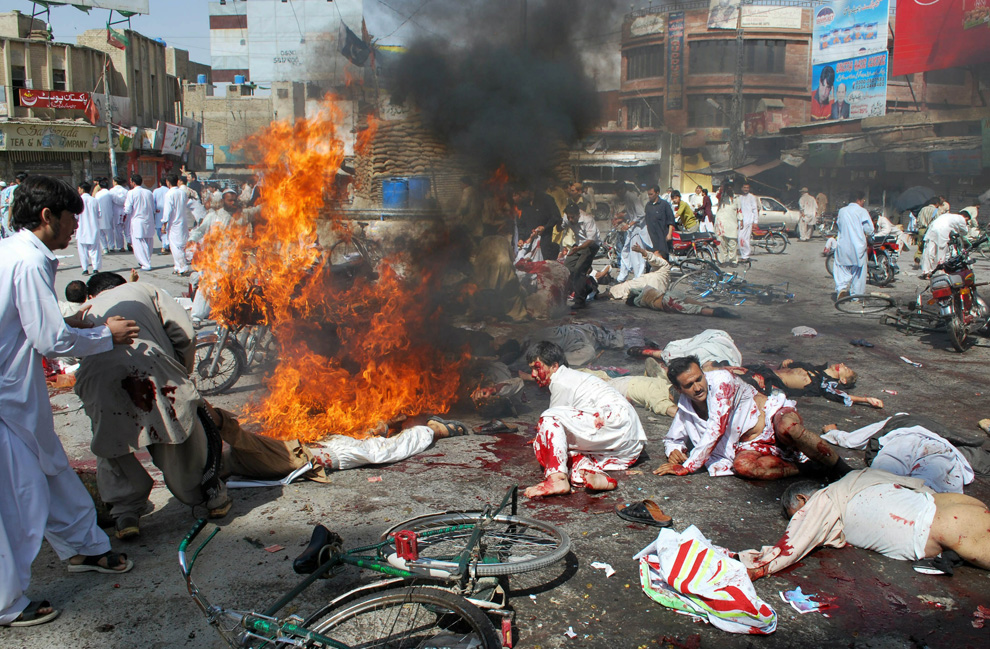
After the assassination of Salman Taseer, Punjab's governor, in retaliation for his public support for Asiya Bibi, a Christian woman sentenced to death under Pakistan's blasphemy laws, I didn't think so much as I felt. My first instinct was not to be a good academic and explain, contextualise or give nuance to the phenomenon of "extremism" or "fundamentalism." I just felt anger, and sadness, and deep confusion as to what fighting these people, or fighting for Pakistan might mean. The important thing is that I did see it in terms of a fight, a desperate struggle. For what? I couldn't say, but at least so that nothing like this would happen again. We're all conditioned, as academics, to be wary of emotional manipulation, but news report after news report of bombings in Pakistan, and gruesome photographs of dead bodies lying in the streets, can really get to you after a while. Seeing the outpouring of support for Taseer's killer - he was quite literally showered with rose petals - deepens the feeling. But I also know that by "fight" I don't mean more American drones, or a new military dictator in Islamabad, or even rallying around the banner of something called "secularism."

In August, I wrote a piece that challenged writer Aatish Taseer's vision of Pakistan. I thought that his call for Pakistan to recapture its lost "Indianness" masked an insensitivity to the country's legitimacy, and I accused him of wanting to save Pakistan without loving it. Now, reading his moving eulogy to his estranged father, I feel a bit embarrassed. Why should Aatish, born in India, raised by his mother, and largely unacknowledged by his father, feel any love for Pakistan? And how would he feel now, after seeing his father murdered by religious extremists? What right do I have to nuance his statements about the threat of the "bearded men"? But I was still right in the end. Aatish passionately believes that, "Pakistan and its founding in faith, that first throb of a nation made for religion by people who thought naively that they would restrict its role exclusively to the country's founding, was responsible for producing my father's killer." Indeed, this was the very reason father and son drifted apart. If Salman was a "Pakistani patriot," Aatish explicitly didn't believe that Pakistan should even have come into being. What room for compromise?
By itself, the statement that the idea of Pakistan was a doomed experiment from the start is not exceptional or particularly objectionable. But Aatish Taseer's solution is troubling: he wishes that "science and rationality" had been "enshrined at the heart" of the nation instead of religion. By extension, should we combat men like Malik Mumtaz Qadir (the assassin) with science and rationality? What chance do these concepts have against the powerful lure of religion; who would then shower him with rose petals?

This debate reminds me of another dead-end, the fate of state-sponsored "disenchanted" secularism in India. After the Ayodhya verdict, when a sitting judge declared he had determined the actual birthplace of Lord Ram, I experienced the same kind of reactionary despair. "To hell with academic critiques of secularism: fight this superstition to the end!" The problem is that the academics may be right. Secularism alone, and science or rationality alone, are not enough to persuade people to stop seeing themselves as having a set of religious or communitarian interests they must defend to the death.

So if we don't have secularism, and we don't want to fall back on state violence, the only thing we have left is ethics. That is to say, human-to-human, day-to-day interaction. What makes the blasphemy laws and the Ayodhya judgment wrong is not so much that they are superstitious or irrational, but that they destroy the ability of human beings - Christians in Pakistan, Muslims and other minorities in India - to live in peace, to move freely through the cities and villages, to draw water or sell their goods in the bazaars, to express themselves without fear of violence or retribution. These are not even necessarily "human rights" at a universal level. They are local and intimate affairs. With regard to Pakistan, what is most urgently needed is not advocating for science and a secular state - an agenda sure to enrage clerics and disaffected young men like Malik Mumtaz Qadir even further. It is, somehow and in a diffuse and imperceptible way, to cultivate an atmosphere where individuals look upon their neighbours with compassion and mutual sympathy. Notions like "pluralism" and "tolerance" are not political slogans; they are ethical targets for individuals to re-train their sensibilities away from conspiracy and paranoia and toward genuine understanding of the lives of others. It may sound like a naive proposition, but it's actually a realistic description of what happens almost every time individuals come into contact without mutual suspicion and violence anywhere in the world. Yes, even in Pakistan.

Tuesday, 10 August 2010

"The State of Pakistan," a new genre of journalism

I don't know what it is about the piece I am about to comment on that made me finally write this post; it could have been one of hundreds of others that have appeared in print and online, from both Western and South Asian sources, over the past few years. Perhaps it is because I am so used to dismissing them as temporary effluvia from the security politics crowd lacking the requisite sense of history, but this time something in me responded to the message. This is Aaatish Taseer's recent article in Mint, entitled "Losing faith in Pakistan."
http://www.livemint.com/2010/08/06210142/Losing-faith-in-Pakistan.html

The interesting thing about this article is that it manages to be half remarkably insightful and half pernicious nonsense. Let's start with the good: Taseer's basic claim is that contemporary religious extremism in Pakistan aims to "cleanse the Islam of that country of its cultural contact with the Indian subcontinent." In practical terms, this refers to the imposition of Saudi-derived ideological puritanism and the political programme of Maududi's Jamaat-e-Islami set up against "the full world, the world of culture, of stories, of songs, of dress, of ornate ritual" epitomised by the "syncretic" Sufis. Taseer is undoubtedly right in saying that the societal conflict tearing Pakistan apart has far, far less to do with clashes of civilisations between West and East than with the largely internal political struggle over the forms public religion should take in Pakistan. Such a position compels us to understand the different fractions and cleavages within the various Muslim movements within Pakistan, as Manan Ahmed pointed out during the height of the "failed state" hysteria in the Western media, aka that "the Taliban are 20 miles outside of Islamabad" time:
http://www.chapatimystery.com/archives/homistan/just_a_thought_v.html

The recent attacks, first on the Ahmadi mosque, then on the Data Darbar Sufi shrine in Lahore, seem to have awakened even the most hopeful and progressive commentators to the existence of a very real threat. If the country as a whole is in no immediate danger of being "Talibanised," still the audacity and increasing frequency with which the attacks are coming raises the question: who is not a kafir now? Alarmism may not be such a bad word anymore. See Raza Rumi's impassioned appeal:
http://lahorenama.wordpress.com/2010/07/20/stop-lahores-talibanisation/

Taseer also very justly points out that far more of an outcry followed the Sufi attack, even among the lamenters. In the official media, of course, passing off the Ahmadi attack as a Zionist conspiracy was not only easier but also de rigueur. On the other side, with the exception of Manan Ahmed's excellent series on the history of anti-Ahmadi legislation (archived here: http://www.chapatimystery.com/archives/category/homistan), the debate is dangerously close to reproducing a "good Sufi"/"bad Wahhabi" dichotomy that has plagued the literature on Pakistan for quite some time.

One take-away point from Taseer's piece is that historians need to pay more attention to the "Islamisation" of Pakistan under General Zia and to the connections, especially via labour migration to the Middle East, between Islam in Pakistan and outside. But we should avoid imposing a dualistic frame over all past events, as William Dalrymple does when he recasts even the history of the 1857 Indian Mutiny as a struggle between the tolerant Sufis of Bahadur Shah's court and the North Indian rebel forerunners of Osama bin Laden. Such wishful thinking avoids the uncomfortable questions about Sufis' role in upholding the feudal order in Pakistan, somewhat forcefully asked in the following article with the provocative title, "The Bad Sufi":
http://www.dawn.com/wps/wcm/connect/dawn-content-library/dawn/news/pakistan/03-the-bad-sufi-ss-02

To better grasp what made me uncomfortable with Taseer's presentation of the story, I re-read the introduction to his otherwise excellent translations of Manto, where he claims that he is rescuing Manto for India out of the ghetto of being considered a "Pakistani writer." By implication he is doing the same thing for Urdu. Similar to his suggestion that Pakistan's problems could be resolved by a rapprochement with some forgotten essence of "Indianness," or as he puts it, the "Indian pink" underneath the "black Arab abaya," this claim has the air of denying the validity or legitimacy of the Pakistani nation itself. Towards the end of the article, the argument gets more and more intense, and in one sentence the problem of Kashmiri azadi is thrown away as a mere fixation of insecure Pakistanis in search of an identity -- which is remarkable, even offensive, considering the massive violence and curtailment of freedoms unleashed by the Indian Army in Kashmir even as we speak. The flavour of the month:
http://kafila.org/2010/07/10/curbs-continue-on-kashmir-media-is-it-martial-law-in-srinagar/

I am, first of all, no nationalist, and least of all a Pakistani nationalist. I have repeatedly said in various conversations on the topic that Pakistan, "moth-eaten" as it was at birth and caught in the paradox between being a "state for Muslims" that was not meant to be a "Muslim state" (Jinnah's utopian dream), divided between Punjabi elites and waves of regional separatism from Bengalis to Balochis, crushed by the army and the centre, has had a sorry run of historical luck. But all that has been over the past 60 years, sab ho gaya and we cannot un-wish Pakistan out of existence. Every single time a Western or Indian commentator suggests that Pakistan is facing an "existential" crisis and goads this enormously diverse and stratified population to breezily "re-think" the basis of their country and to learn "new narratives," the implication remains that the people of Pakistan are somehow a "problem people," engaged for over half a century in the illicit enterprise of having a country. History can't be re-written overnight; as Marx once wrote, "Men make their own history, but they do not make it as they please." In Pakistan's case, the fight for social justice, democracy, and pluralism can only start from the rubble around us, brick by brick. It might also have to happen under the same green-and-white flag at the end of the day.

Ayesha Jalal began her Manzur Qadir Memorial Lecture of 1989 in Lahore, by saying that she loved Pakistan "with the same complicated and consuming passion" with which Braudel loved France. The problem with most of the purveyors of the "State of Pakistan" brand of journalism in India and the West is that they wish to save Pakistan without ever having loved it, at least a little bit.

Sunday, 28 December 2008

Democracy and Popular Protest in India


Perhaps the most remarkable outcome of last month's attacks in Mumbai was not the sudden realisation by many in the West that India, as the world's largest democracy, was an ally worth standing by far more so than our friend for so many decades, Pakistan. There are serious questions on a large geo-political scale that need asking, but they are part of the ebb and flow of statecraft in South Asia and will not find easy answers soon.

No, what is downright amazing is a less-reported story that, following a wave of popular protests over the handling of the attacks by the Indian government, the Home Minister and national security adviser resigned. The BBC says "hundreds of people took to the streets" in a show of demanding accountability for the government's failure to protect its citizens:

http://news.bbc.co.uk/1/hi/world/south_asia/7757122.stm

Reading this story from the U.S., where the parallel with 9/11 has been pushed repeatedly by an unimaginative media, one is struck by the incongruity of such a response: after all, when their country was attacked, why did Indians not rally around their leaders and give Manmohan Singh a 90% approval rating, as George W. Bush was honoured seven years ago? The answer lies, shockingly for Westerners accustomed to believing that their variant of "democracy" is the highest stage of political development, in the truly substantive nature of Indian democracy. The Indian public sphere is not content to shore up the establishment in a show of good faith and solidarity, as the docile and ill-informed American public did. No, the supposedly flawed and backward Indian democracy produced a textbook response to the failure of its government. Where were the masses of people in the streets demanding to know what the Bush administration knew, and did, about terrorism in the year before 9/11? Why was that infamous P.D.B. of August 2001 entitled "Bin Laden determined to strike inside the U.S." not burned in effigy by angry mobs on the streets of New York, Cleveland, and Omaha? And why, if Bush and his national security team presided over the most devastating attack on American soil in history, were they furthermore given carte blanche on their judgment in starting a war?

The answer lies in different traditions of democracy in the U.S. and India, indeed in the differential basis of the nation-state. The U.S. government is an entrenched and hegemonic apparatus that presides over an apathetic and generally politically uninvolved consumer society. In India, as Dipesh Chakrabarty has brilliantly pointed out in a recent essay entitled "
'In the Name of Politics': Democracy and the Power of the Multitude in India," traditions of popular protest by workers, peasants, and other marginalised groups survive from the early 20th-century struggles of the independence movement to challenge the nation-state. Nehru was opposed to any kind of "unrest," believing it to be incompatible with a "civilised" and mature democracy (where tamer forms of accountability like petitions and the ballot box should prevail). Of course, what the nationalist elites continually failed to understand about the character of the Indian nation was the vast spectrum of minority interests found within it that could not be cajoled, appeased, or integrated without a painful process of adjustment (in other words, that hegemony was hard to come by). In all, this adds up not to a backward and unruly system but to a rich, vibrant, and relevant sense of democracy in India, which should give skeptics about India's future at least some consolation in these dark times.